Why we invested in BRUM
Some markets look inevitable at first glance. Driving education in Italy is one of them. Every year, hundreds of thousands of people go through the same process of getting their driver’s license. Demand is stable, the service is essential, and yet almost everyone who’s been through it will tell you the experience is awful.That’s why we invested in BRUM.
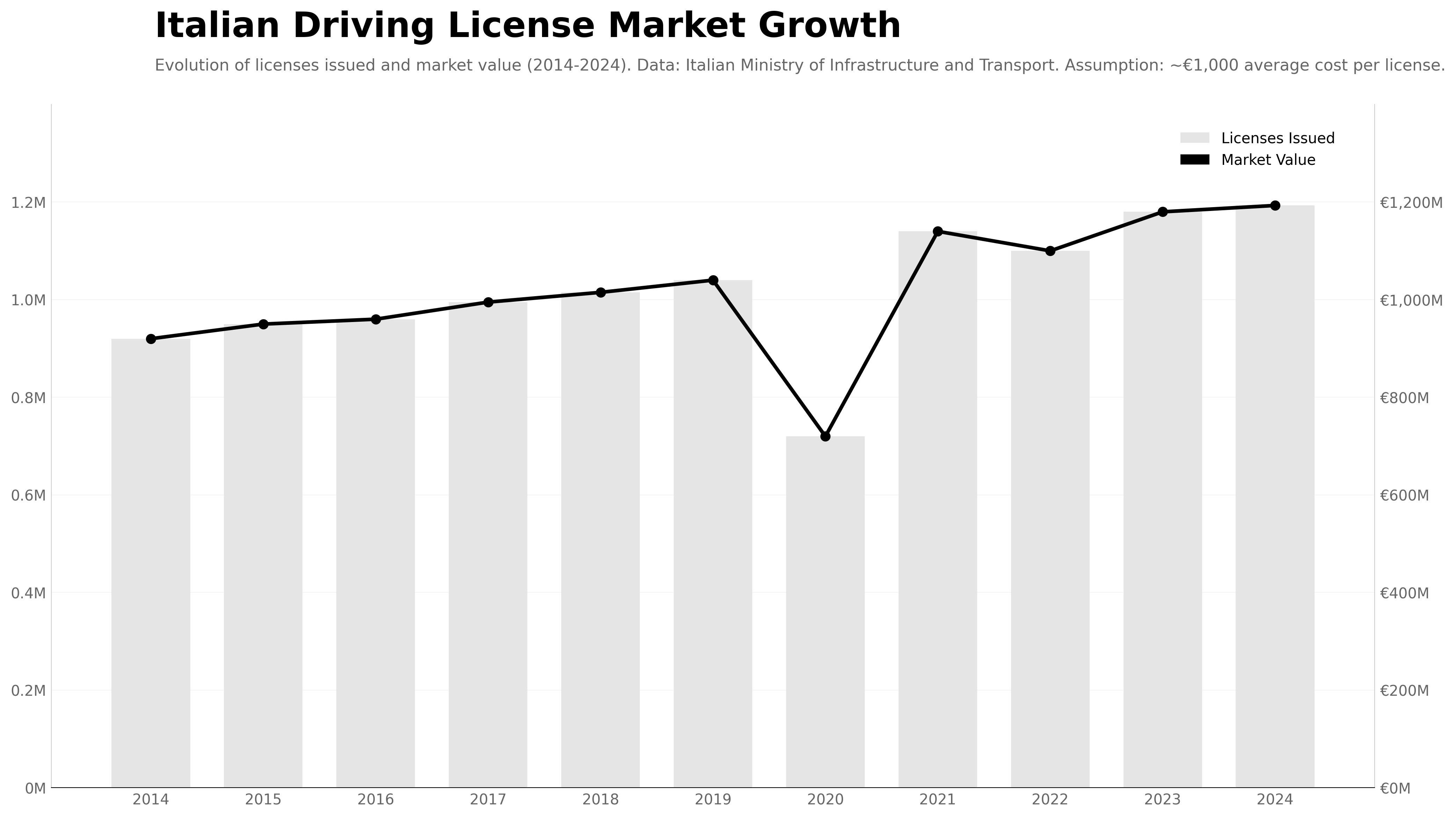
A €1B market that hasn't changed in decades
Italy’s driving school market processes over 850,000 new drivers every year. That’s over €1B in annual spending on a service people can’t really opt out of. Whether the economy is up or down, people still need to drive.But while demand stays constant, the experience is stuck somewhere in the 1990s.Students deal with opaque pricing, weeks of waiting time, bureaucratic chaos, and a theory exam most people fail the first time around. Walk into a typical driving school and you’ll find manual processes, paper forms, and instructors managing everything through WhatsApp. Good luck finding prices online. We checked, and fewer than five schools in Milan actually publish them.For Gen Z, this feels absurd. They’re used to booking everything from workouts to therapy through an app. But when it comes to something as basic as learning to drive? Nothing.The part that got us wasn’t just how bad it is. It was that nobody had really tried to fix it.
So why hasn't anyone fixed this already?
When you see a market this broken, the obvious question is: what’s stopping someone from building a better solution?In Italy’s case, it’s regulation.Indeed, If you want to operate at scale, you still need a physical presence in every province you serve. That kills the pure-play digital model and explains why most startups in this space have stayed as theory-only apps—useful, but not transformative.So you end up with a weird equilibrium. Traditional driving schools are protected by regulation but have zero incentive to innovate. Digital players can nibble at the edges but can’t build a real business.That doesn’t mean the opportunity is dead. It just means the winning model has to be different. You need to go hybrid.
BRUM rebuilt the whole experience, not just part of it
What clicked for us early on was that BRUM wasn’t trying to sell software to driving schools or build yet another theory app. They were rethinking the entire student journey from scratch, while staying completely compliant with local regulation.Here’s what they built: a digital platform for theory prep that actually works, with structured lessons and real-time feedback. Centralized admin for all the bureaucratic nightmare stuff: documents, exam bookings, timeline tracking. Online scheduling for practical lessons. And critically, a physical network of schools they either acquire or partner with to stay regulation-compliant.For the student, it finally makes sense now. You see prices upfront, you track your progress, you book lessons when you want. One login, one interface, start to finish.The full-stack piece matters here. In regulated markets, you don’t win by being clever around the edges. You win by controlling the whole stack and actually delivering a better product.
France and Germany already proved this works
One reason we moved quickly was the comparable markets in Europe.France has Ornikar, which has raised over €100M and basically owns the category now. They started the same way—digital theory, hybrid model, city-by-city expansion. It worked because once you give students a taste of what the experience should be, they don’t go back.Germany has similar dynamics with 123Fahrschule consolidating a fragmented market through better tech and operations.Italy is a few years behind, but not because Italians don’t want this. It’s just that nobody credible has tried yet. There’s no Ornikar equivalent here. No one has taken the space seriously.That’s actually the opportunity. We think Italy is hitting the same inflection point France hit around 2018. The infrastructure is there, the regulatory environment is workable, and students are ready. It just needed someone to build it properly.
We led the Seed round, then doubled down at Series A
When we first invested €3.5M to lead BRUM’s Seed round, they were still validating the basics. Does this actually work? Will students pay? Can we scale this city by city without breaking the model?A few months later, the answers were clear. Student volume grew consistently, unit economics improved, CAC came down. More importantly, they built a playbook. Open a city, partner or acquire schools, onboard students, optimize. Rinse and repeat.This isn’t some viral consumer app that goes from zero to a million users overnight. It’s a grind. You’re dealing with real operations, instructors, scheduling, regulation, local partnerships. It’s messy and it’s hard, which is exactly why we like it.We didn’t hesitate and decided to led the €5M Series A round because our conviction had only gone up.
It's all about execution now
Driving education is a delicate space. The product has to work, the operations have to run smoothly, and you need people who know how to scale distributed, people-heavy businesses.BRUM’s team has done this before. They’ve built consumer brands, managed complex operations, and figured out how to acquire customers efficiently in competitive markets.In markets like this, execution is everything. The idea is obvious, everyone knows driving schools suck. What’s not obvious is how to actually fix it at scale while staying profitable and regulation-compliant. That’s the hard part, and that’s where the team matters.
Scale is quiet but it compounds
One thing we’ve learned backing companies in these types of markets is that growth doesn’t always look impressive from the outside.You open a city. Then another. You refine the process. You build supplier relationships. Your brand starts to mean something locally. Students tell their friends. What looked like a single city operation starts to become a network, and that network starts to have real advantages.It’s not the kind of growth that makes headlines, but it’s durable. These businesses compound slowly, and once they hit a tipping point, they’re very hard to catch.BRUM is still early in that journey, but the trajectory is right. Build density, get the operations tight, let the model do its thing. That’s the path.
Why this fits Italian Founders Fund
At Italian Founders Fund, we specifically look for founders going after big, messy, real-world problems that most investors think are too boring or too hard.BRUM isn’t inventing new behavior. They’re taking something people already have to do and making it not terrible. They’re not looking for regulatory loopholes. They’re working within the system and modernizing it from the inside out.Big market, structural inefficiency, hybrid model that’s hard to replicate, strong team that knows how to execute. That’s why we invested originally and why we’re doubling down.We’re excited to keep building this with the team. Driving education in Italy has needed this for a long time. We think BRUM is the company that finally makes it happen.

Back Home
JOIN OUR SUBSTACK
to get insights, stories, and updates from the Italian founders ecosystem.