

Most funds don’t have a network problem. They have a network shape problem, and they have never looked at the shape.
In venture, access is everything. Every fund says so. But access is not the same as knowing a lot of people, and almost nobody can draw the network that produces it, let alone tell you whether theirs is built to compound or built to stall. After six months in VC, here’s how I learned to look at network.
Thanks for reading Italian Founders Fund's Substack! Subscribe for free to receive new posts and support my work.
Before we start, a quick introduction: I am Lore. Six months ago I started working in venture capital, joining IFF while finishing my double degree between Bocconi and St. Gallen. Before that I worked in fintech, studied in Siena, and spent a year in Oxford.
Moving between places like that teaches you something. The same subject looks completely different depending on where you study it and who is around you. What always fascinated me was how someone from a different background thinks their way to a conclusion, which is even clearer if you discuss the same idea with people studying physics, economics, philosophy, or whatever subject. This is what pushed me to talk to everyone. People I understood, and especially people I didn’t.
Which is a little ironic. I have spent all this energy meeting people in person, and never properly used the tools built for exactly that: LinkedIn, Substack, X. So I guess writing a small thing about networks is the right way to finally start (??)
In the last six months I did what every new “investor” does. I went to everything. Demo days, LP dinners, panels, panels about panels, and panels about how to do panels about panels. And at every single one, someone repeated that venture capital is a relationship business.
After the fiftieth time, I started wondering what that actually means. Last week I got on a call with a professor at Bocconi whose own research is on exactly this, finding the influential nodes inside complex networks. She introduced me to the mathematical side of it. I promise not to drag you through the math (though consider that the same network math apparently predicted the new Pope…). Anyway, she helped me put language on something I had been sensing at all those events. The value of a network is in its shape more than it is in its size. It is in its shape, and almost nobody in our industry ever looks at the shape of theirs. This piece is my attempt to show you how to look.
The two shapes
Imagine mapping an ecosystem as a graph. Investors, founders, and operators are the dots. Co-investments, board seats, hires, and working relationships are the lines. Every network you will ever be part of is built from two basic patterns.
The first is the triangle. A introduces B to C, they work together, it goes well, they do it again. Over time the lines between them thicken. Sociologists call this closure. Closed triangles produce trust. Diligence gets done faster and bad behaviour gets punished quickly because everyone talks to everyone.
The second pattern is the bridge. A single line connecting two groups that otherwise share no members. Mark Granovetter showed fifty years ago that new information travels through these ties, because everyone inside your own cluster already knows what you know (Granovetter, 1973). Ronald Burt later showed that people who sit on these bridges, the brokers, capture outsized value because they see combinations that nobody trapped inside one cluster can see (Burt, 1992).
But two networks can have the exact same number of ties and behave completely differently.
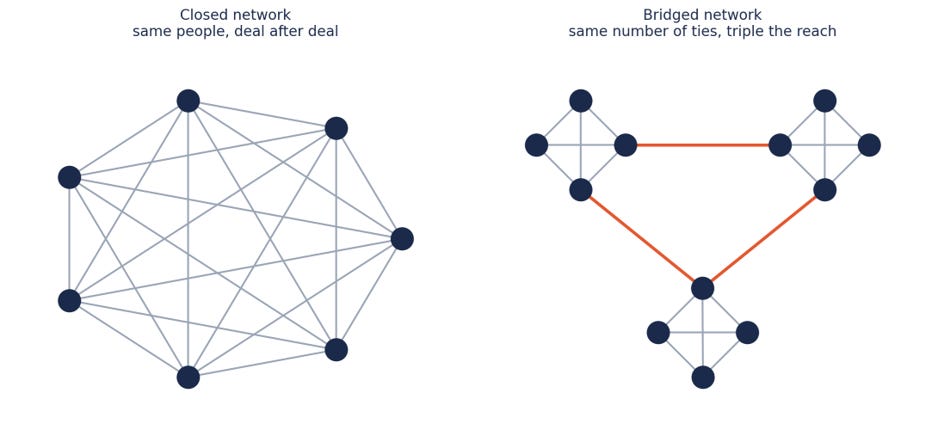 Same twenty-one ties. On the left they keep seven people locked together. On the right, three of them reach outward and put twelve people within reach.
Both graphs have the same number of ties: twenty-one. The left one is a fortress. It spends all twenty-one keeping seven people locked together. Maximum trust, and the world ends there. The bridged network spends the same twenty-one, but three of them reach outward, and suddenly twelve people are within reach across three groups instead of seven inside one. These two networks share the same “relational budget”, but their reach is very different. There isn’t one that is better than the other, but the outcomes they produce are different, with the first building trust and the second building reach.
Why venture is more exposed to this than almost any business
Venture is unusually sensitive to network shape because the product itself moves through the graph. Deal flow is information traveling along ties. Follow-on rounds are trust traveling along ties. Talent, customers, LP commitments, all of it flows through relationships, which means the structure of those relationships is the infrastructure of the whole business.
An investor’s position in the co-investment graph can be measured, and it moves over time. The interesting question is where the investor sits, and how a firm climbs from the edge of the network toward the center.
For me the hard part is knowing what each connection is actually for. Should I have a thesis that decides who I talk to, or should it be free of any short-term aim? I am not sure which is the better strategy, and I will admit I still sometimes hold back, worried the other person will not care about my take, and so the connection never gets made.
The same mechanism shows up beyond venture. Spreading, whether of a virus, a meme, or a hot deal, is driven by the superspreaders, the rare people whose connections cut across communities.
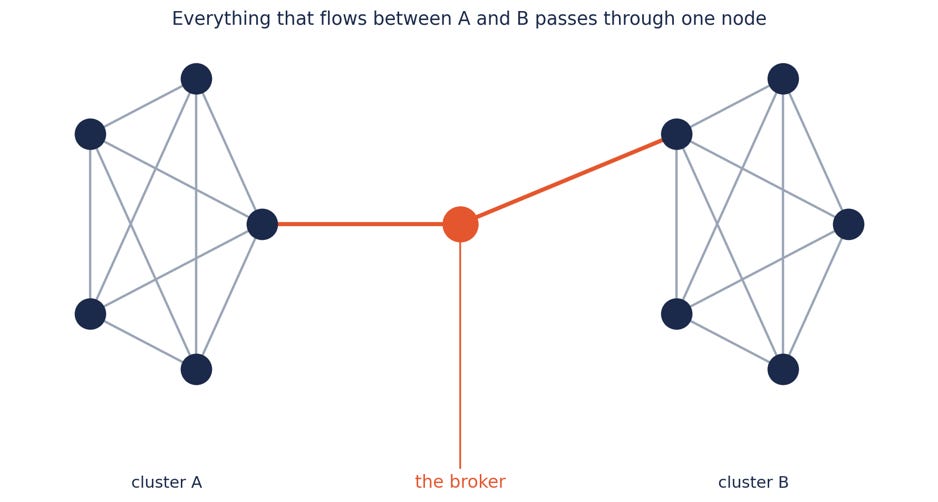 The broker's power is structural. Remove that one node and the two worlds fall out of contact.
A quick diagnosis: are you a fortress?
All of this stays abstract until you turn it on yourself, so here is a test you can run whenever you want. Write down your last twenty meaningful professional interactions, the ones where real value was exchanged. For each, ask two questions. Was this person new, or someone already inside my circle? And do they simply know the people I already know, or do they open a door to a group I could not otherwise reach?
Then count. If more than roughly four out of five were already inside your circle, you are running a fortress. Dense, trusted, comfortable, and capped. It is a crude cut, not a scientific one, but crude is the point: it takes an evening and it tells you which of the two shapes you are living in.
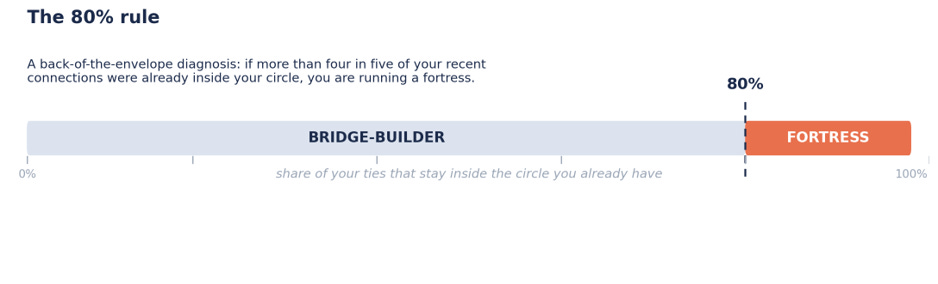 A blunt rule you can apply to your own last twenty connections.
When I ran it on myself, the result was humbling. Almost everyone was already inside the knot, and the few new names turned out to be friends of friends. Six months in, I had built weight, but not reach. I don’t think I am the only one. Take the last demo day I went to. Setting aside the “hellos” and small talk, I had five real conversations: three investors, two founders. One of the investors is a good friend, and we had an interesting exchange about how his fund looks at angel rounds, incremental rather than disruptive. Then I spoke with two investors who had been presenting on a panel. I did not know them personally, and yet the connection was already there: they do the same job, same geography, and already knew most of IFF team, which means they sit one step from my own colleagues. Same cluster, different faces. Of the two founders, I knew one and the other was completely new. Guess where I spent less time? Of course, with the new one.
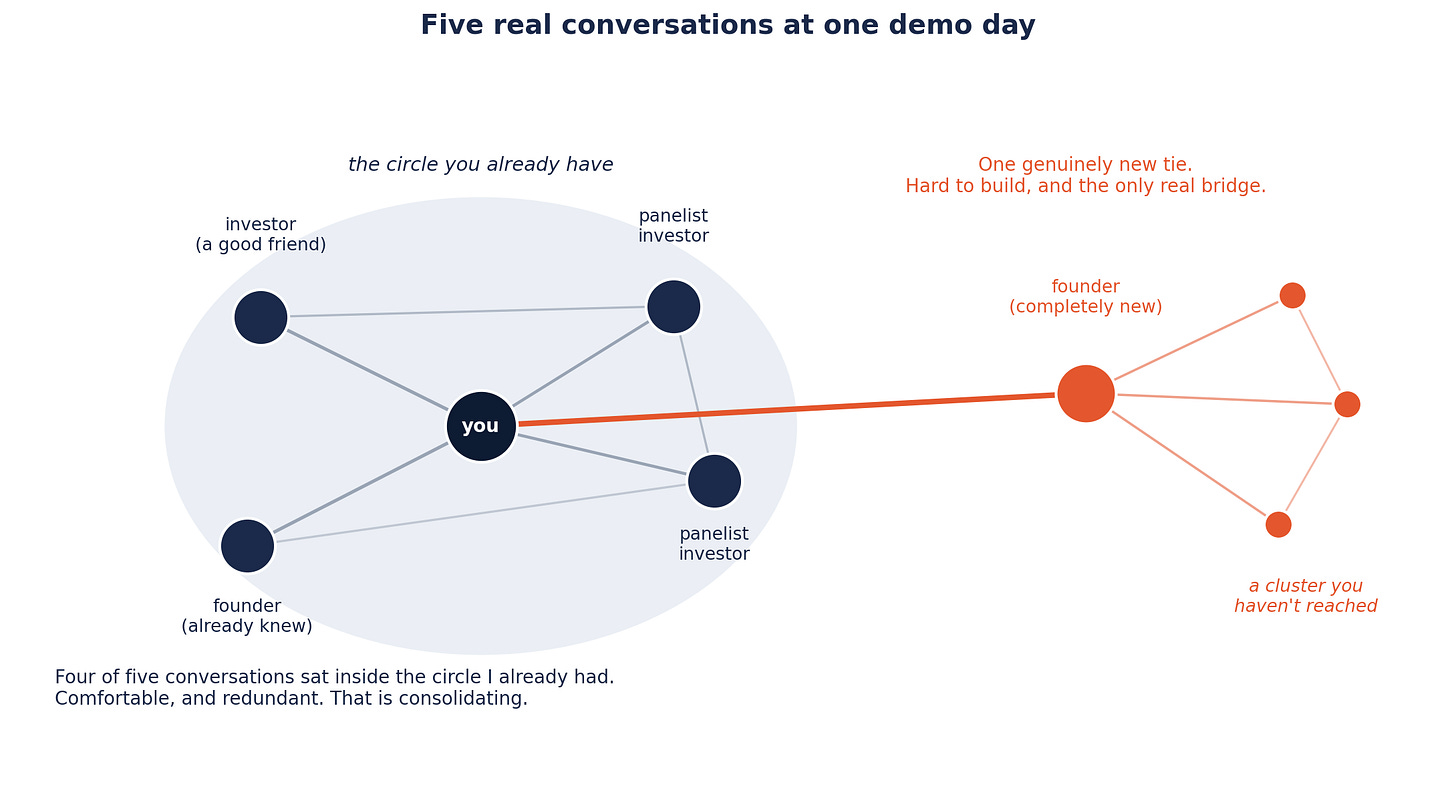
That is the problem with bridges. They are hard to create. Building one means starting an actual relationship, and the further away the person is, the fewer shared thoughts you have to make it easy. Everything pulls you back toward the people you already know. (It also raises a real question I still have not settled at these events: do you invest in your own network, or the fund's? Less trivial than it sounds). If a connection feels easy, you are almost certainly consolidating, deepening a tie inside your cluster. If it feels hard, awkward, low-context, unsure whether the other person even cares, you are probably building a bridge. While it might feel uncomfortable to build a new bridge, discomfort is at the basis of a network with a vast reach.
Does Italy need more networking, or better bridges?
You could read all of the above as a critique of the Italian ecosystem, which is small, concentrated in a few cities, and rich in exactly the kind of repeated triangles I have been describing. The same names recur around the same deals. I have watched it up close for six months.
But there’s an optimistic reading, and it comes down to a single point. Italy does not need more networking. It needs better bridges. Small graphs rewire fast: in a network our size, a handful of new bridges changes the topology of the whole system, in a way that would be impossible in San Francisco. Every fund that leads a round with a foreign co-investor, every operator who comes back from Berlin or London with live relationships, every angel who backs a founder outside their social circle is adding edges where the graph is thinnest. The marginal bridge in Italy is worth more than the marginal bridge almost anywhere else.
At IFF, one of our biggest wedges is literally that everyone on the team lived in different countries doing different jobs. There are bridges everywhere, and they compound over time. There is a common take that vertical funds are better, because you can go deeper in diligence and extract more value from one domain. The other side of that coin is that a horizontal fund like IFF can compound far more bridges. And if venture is about finding outliers, maybe you need outlying methods to do it: being interdisciplinary, pulling context from everyone, learning from professionals far outside your own field.
It is also, if you think about it, what Albi was describing in his last piece from another angle. Media is bridge-building at industrial scale. A podcast episode or a reel that reaches ten thousand people you have never met is a machine for generating weak ties, the exact ties a closed ecosystem lacks.
Look at your graph before you grow it
I am new to this industry, so take everything here “con le pinze.” I had to find a way to make sense of how I am growing in this world, and this is the frame I am going to use. Maybe it works for someone else too.
To sum everything up, and if you can’t be bothered reading the whole article, here is the TLDR:
Every network has a shape which determines what that network does well: close networks build trust but lack reach, bridged networks are stronger at creating new connections but weaker at creating trust.
You should evaluate the shape of your network to understand where you fall and how to improve it.
Ideally you will develop a deep network with a lot of bridges, but sometimes there’s a trade-off between the two and you’ll need to prioritize one over the other.
I am new here and still building my thesis, so if you see it differently, tell me. Happy to take any pushback and sharpen my thesis. And if any of this resonated, reach out. Always happy to meet new people.
Thank you for reading this far,
Lorenzo