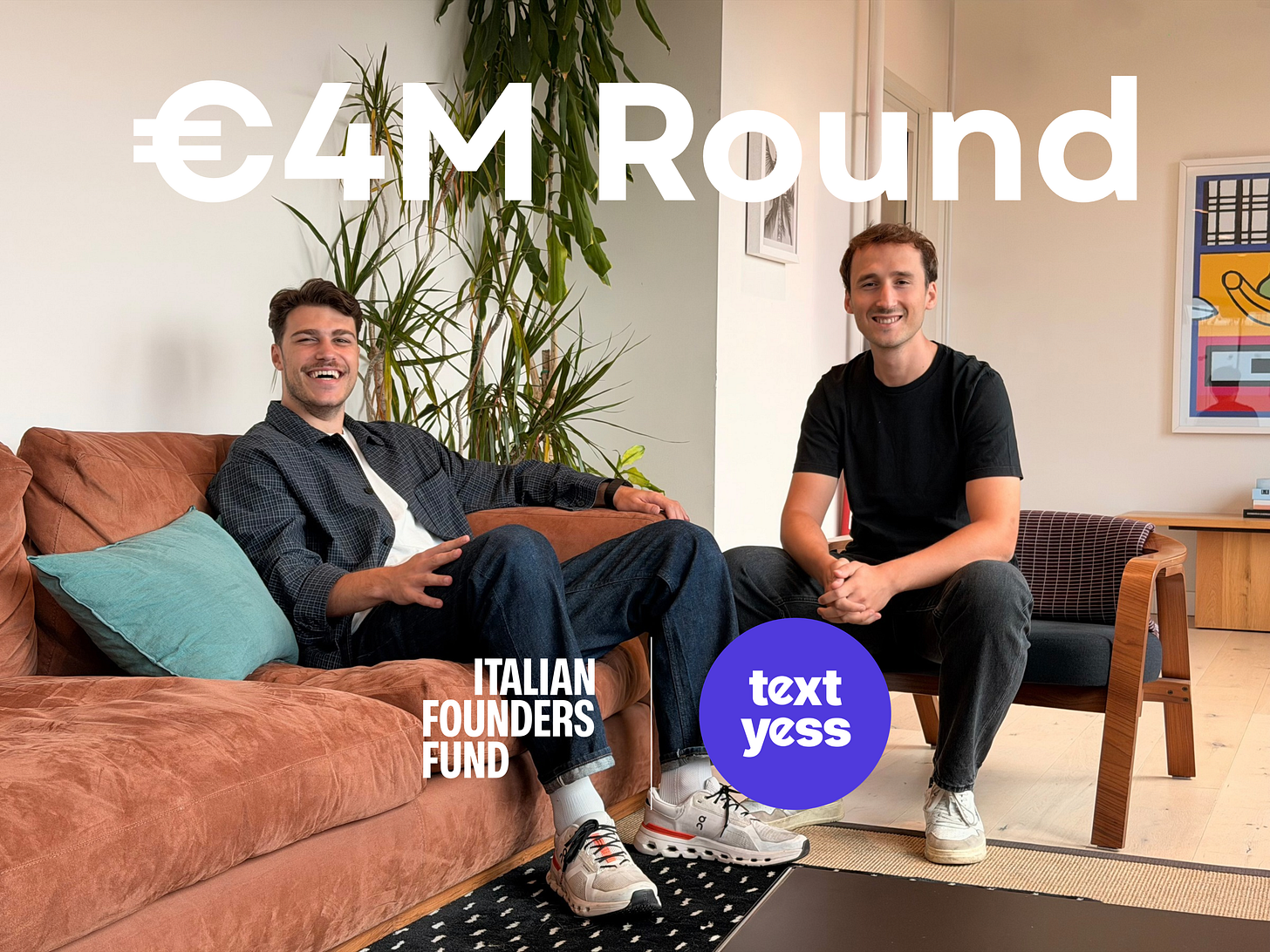
I met Riccardo in person a few times before he even started to raise. By the third conversation, I had developed a slightly annoying feeling: he had already thought about almost every question I wanted to ask, usually in more depth than I had. Some founders are very good at answering questions. A much smaller group makes you realize halfway through the conversation that you need better questions (Riccardo was in the second group).
He started making money online as a teenager in Sicily, at a time and in a place where building things on the internet was not exactly the obvious career path. When I asked him what he still felt he had to prove, his answer went back there: to growing up feeling that the path he saw for himself made very little sense to the people around him. There is something quite powerful about founders whose ambition comes from that place. Not “I want to build a startup”, but a much older curiosity around how far can I actually push this?
Subscribe for more behind the scenes of our investments!
We’ll get into more details later, but there is one number that kept bothering me throughout our diligence on TextYess (if you have been reading some of my articles, I tend to be quite founders + ROI-obsessed)

For every €1 a customer spends on TextYess, the platform currently attributes roughly €15 of revenue back to that customer. My first reaction when Riccardo showed me the data was, more or less: there is no way this number is real. So we spent quite a bit of time trying to understand what sat underneath it. And somewhere in that process, we realised that the interesting question was no longer whether TextYess had built a very good WhatsApp commerce product. It was whether WhatsApp was simply the entry point into something much bigger: an AI-native CRM that increasingly decides what a brand should do, rather than waiting for a marketer to tell it.
That is the company we decided to invest in.
The internet made commerce scalable. It didn’t make it personal.
Think about the last ten e-commerce brands you bought from. You probably received some version of the same thing from most of them:
Welcome email
10% discount
Abandoned cart
“WE MISS YOU!”
Black Friday
… Unsubscribe :)
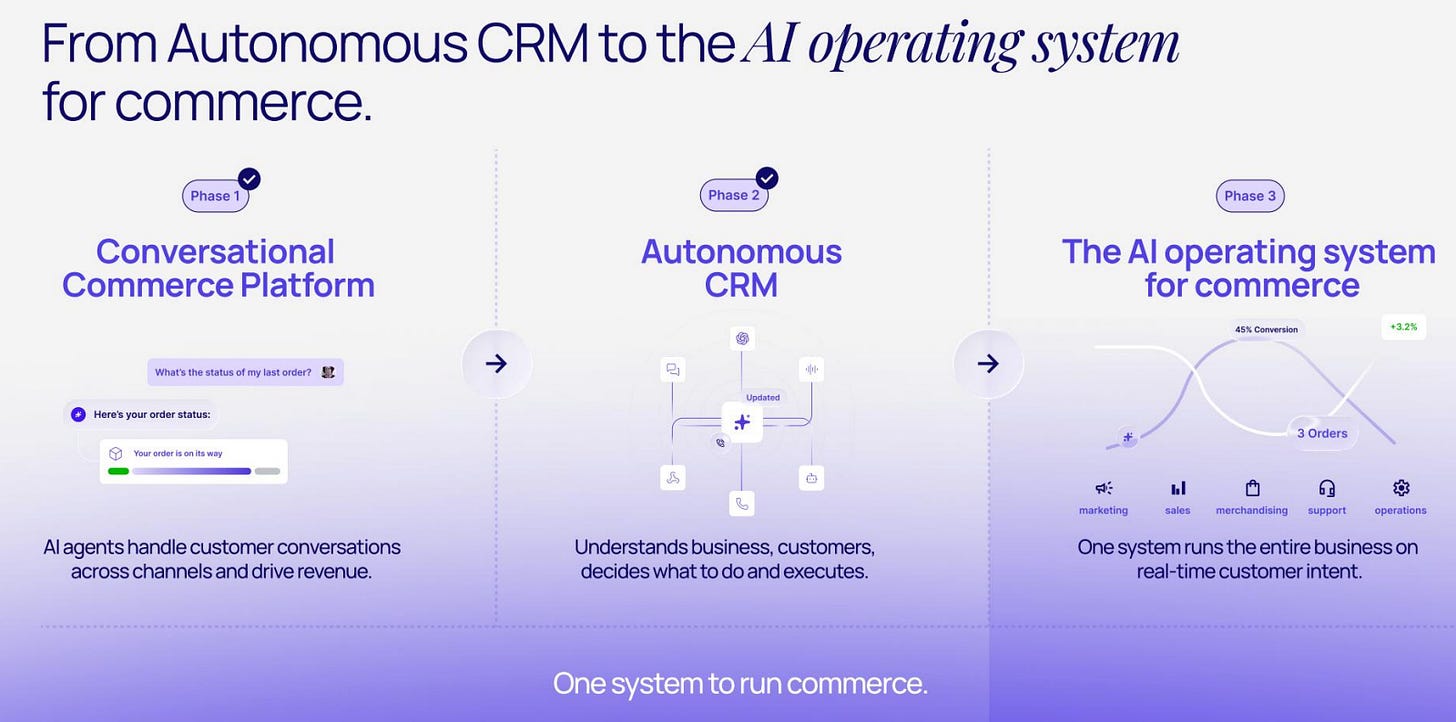
This is slightly absurd when you think about how much brands actually know about us. They know what we bought, when we bought it, what we looked at, which products we returned, what we asked customer support. Sometimes they have years of data on the relationship (!). And, yet, most CRM still works as a very sophisticated way to send roughly the same message to a very large group of people.
I really don’t think the problem is a lack of data. It is that somebody still has to do all the thinking. A typical e-commerce team has Shopify, Klaviyo or Brevo, Gorgias or Zendesk, analytics tools and usually a healthy number of spreadsheets. Each product gives them another dashboard to look at. Someone still has to understand what happened, decide which segment matters, build the campaign, write the copy, choose a channel, schedule it, measure it, and then start again. As the stack became more sophisticated, the operator somehow remained the workflow engine.
The timing also matters. Until recently, software could store customer data and automate predefined workflows, but it could not reliably reason across thousands of messy interactions and decide what to do next. LLMs change that. For the first time, the intelligence layer can sit inside the workflow rather than on top of it.
WhatsApp is the wedge. The CRM is the company.
TextYess started from conversational commerce, and particularly WhatsApp. I think that made a lot of sense. WhatsApp gives you something email never really did: the conversation. An email platform sees that you opened, clicked and purchased. A conversational platform can also see that you asked whether the shoe runs small, that you were worried it would not arrive before Friday, that you wanted it in black, that you almost bought it but changed your mind because of the price.
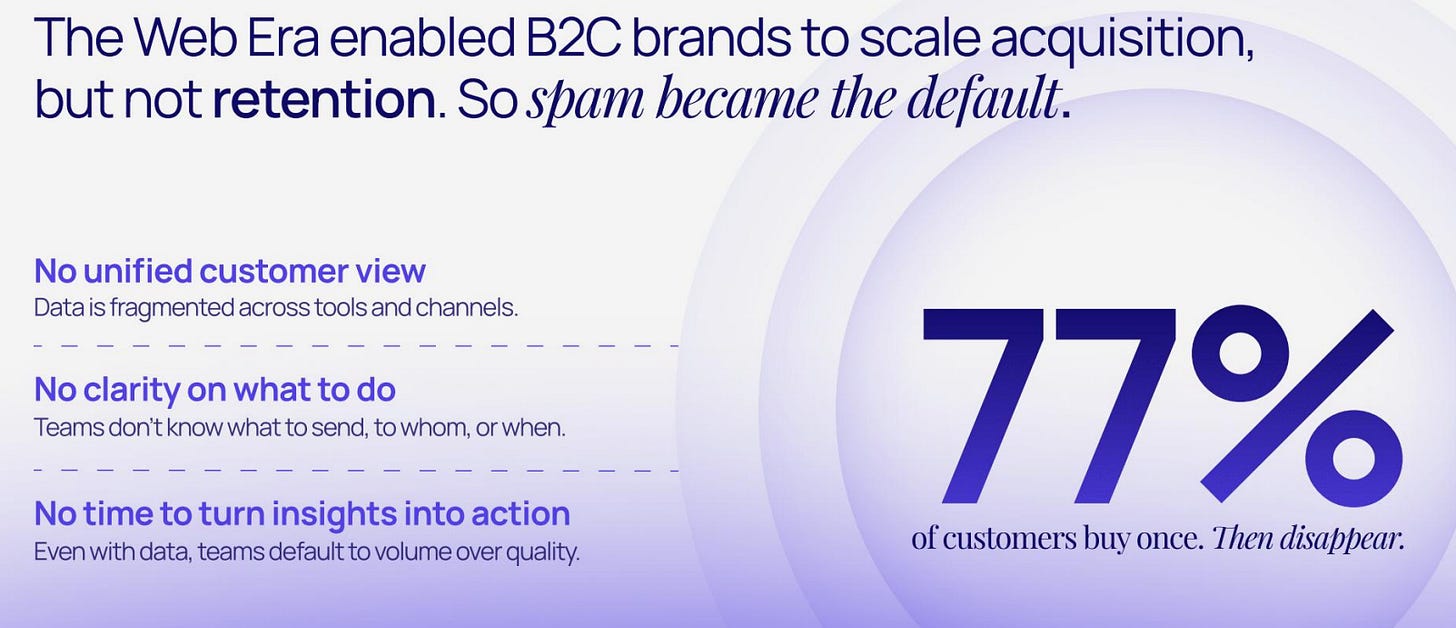
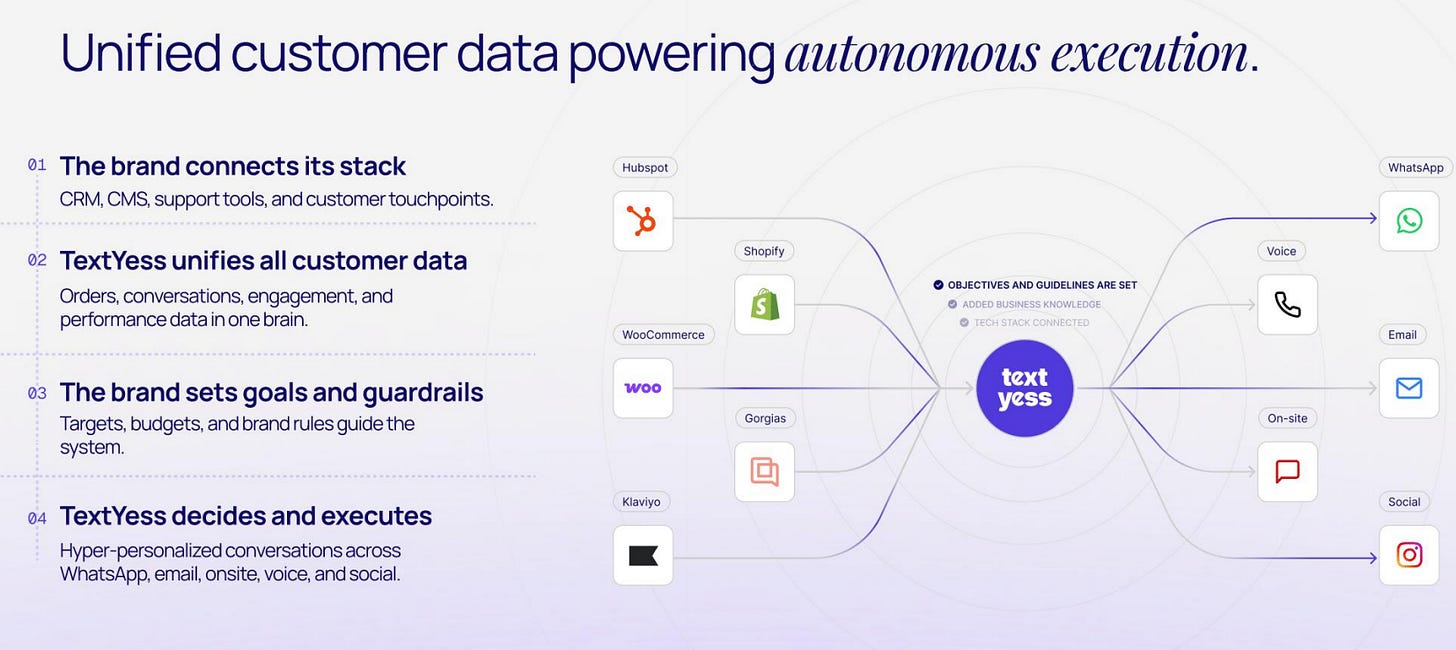
Riccardo and Edvaldo increasingly realized they were not building “WhatsApp software”. They were accumulating the ingredients required to build the customer intelligence layer underneath the whole commerce stack. A brand connects TextYess to its store and existing tools. TextYess brings together orders, customer profiles, conversations, campaign performance, product data and engagement into one intelligence layer. From there, the system can increasingly answer four questions:
Who should I talk to?
What should I say?
On which channel?
And when?
Eventually, the idea is that the marketer does not build every workflow at all. They set the objective and the constraints. The system does the work.
That is why the analogy we kept coming back to internally was “Attio for B2C”. B2B CRM is already being rebuilt around AI-native products. In B2C, there is still no obvious AI-native system that owns customer data and autonomously decides what to do with it.
The number we kept coming back to
Remember the €15? We obviously spent quite a bit of time trying to break it: attribution in marketing is never perfect, and giving one channel all the credit for a purchase is always going to be debatable (huge thanks to all the experts whose brains I've been breaking to understand how this thing works!). But the more interesting signal was somewhere else: customers expand. TextYess has 141% NRR in its core ICP, around a quarter of new customers come through word of mouth.. If customers keep spending more, recommending the product and moving more of their CRM activity onto the platform, something is clearly working.
From software you use to software that works for you
The part I find most interesting is where the product is going next.
Instead of a marketer logging into a CRM and building a campaign manually, the system should increasingly say:
Here is the opportunity I found.
Here is who I think we should target.
Here is the message.
Here is the expected outcome.
… Do you want me to run it?
The longer-term vision goes much further: from autonomous CRM to an AI operating system for commerce, progressively taking on more of the work currently done by internal teams, agencies and freelancers.
Okay, but what about Klaviyo?
The answer is not “Klaviyo won’t build AI”. I think they will. So will a lot of other players. The market is clearly converging towards the same destination: fewer dashboards, more intelligence, more autonomous execution. So the bet is not that TextYess has invented something nobody else can see. The bet is that starting AI-native, being extremely close to customers and moving very quickly really matters during a platform shift like this. Their advantage today is not some magical proprietary model. It is the combination of context, product velocity, customer proximity and the fact that every new channel and integration feeds the same intelligence layer.
And finally, the team
I started with Riccardo because founder quality was a big part of our decision. But the pairing with Edvaldo is equally important. They met through YC’s co-founder matching platform (basically Tinder for founders :) )and are unusually complementary. Riccardo is commercial, instinctive and extremely close to customers. Edvaldo is analytical, technical and much more systems-driven. Around them, they have built a small but very strong team with experience across AI, commerce and SaaS.
So what are we betting on?
We are betting that the way consumer brands manage customer relationships is going to change quite radically. That software will move from helping people execute decisions to increasingly making and executing those decisions itself. And that conversations (not just clicks, orders and page views) will become an important part of the intelligence layer underneath commerce. There is still a lot to prove, but the combination of founder quality, customer love, ROI, retention and speed made this a bet we were very happy to make.
We’re excited to be part of TextYess’ €4m round, alongside VC Partners and Entourage, and even more excited to see how far Riccardo, Edvaldo and the team can push it.
-Virgi