The story of human progress has largely been a story of how much energy we have been able to create and put to productive use. Innovation needs energy because new technologies tend to be more energy-intensive. Today, this is especially true with the advent of AI, as energy demands for major AI labs are growing exponentially. By the end of next year, OpenAI and Anthropic are projected to reach 10 gigawatts of capacity each. Looking toward 2030, Sam Altman has expressed a goal of adding 52 gigawatts a year, while Elon Musk has discussed targets as high as 100 gigawatts a year (source).
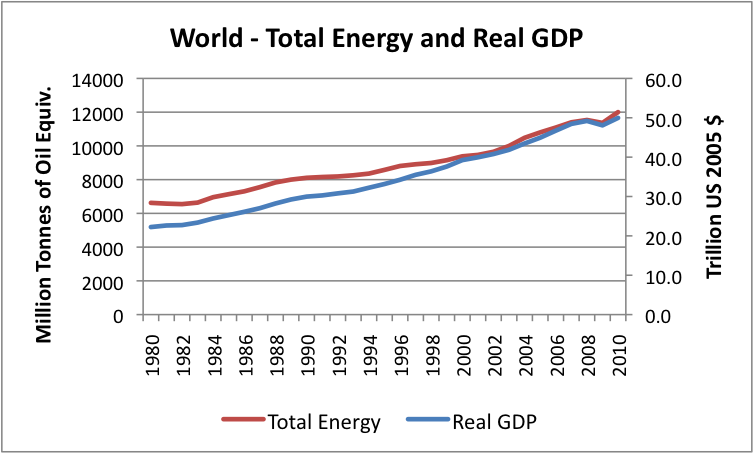
While some developed countries have been able to decouple energy from GDP growth over recent years, if we look at the global picture, growth has been correlated with energy consumption and creation.
When I hear big problems, and ambitious people wanting to tackle them, I light up. So you might imagine my reaction when I heard that two droputs yet to turn 25 told me they wanted to build the operations intelligence layer for renewable energy asset managers, and play their part in solving one of the biggest problems of the 21st century.
This is how the Invertix story began.
What immediately stood out after talking to Joseph and Kaan is their dedication and pure hustle. When I met Joseph, he had been building for some time, mostly experimenting with consumer apps. Eventually, he realized that his life’s work would not be a get-rich-quick consumer app: he wanted to tackle one of the biggest problems of our generation.

Joseph began reaching out to people, lots of people: 5000 of them. This got him banned from Linkedin and Whatsapp (I wasn’t even aware you could be banned from Whatsapp, you see what I mean when I said PURE HUSTLE?). All of those messages turned into 300 conversations with professionals in the energy sector.
So now you know Joseph. Let’s talk about Kaan:
24 years old. Studied electrical engineering and did research in bachelors in applied math and AI safety, won Rel-ai: a grant for AI safety talent. Learned software and coding on his own, worked in autonomous driving at BMW, refused job offers from the best quant firms to start a startup. Dropped out from masters in robotics and AI. Did research in AI for chemistry with MIT and TUM AI.
Kaan is the classic example of a young, hungry person that has amassed deep technical expertise and can credibly talk to energy asset managers without flinching.
In the beginning I honestly wondered whether such a young team could pull this off, but after seeing the amount of grind, passion, and energy (pun intended ;)) they put into their work, I knew it would be a mistake not to bet on them.
The problem
While talking to hundreds of energy professionals, Joseph realized that renewable energy asset managers face a big problem: As portfolios scale from single-digit GW to multi-GW fleets, the operational data infrastructure has not kept pace. Every plant integrates with multiple vendorspecific SCADA and monitoring systems, O&M ticketing platforms (CMMS), financial models, and document repositories. None of these systems talk to each other. The result is a fragmented operational reality that forces companies to rely on what Invertix calls 'Human Data Bridges': expensive consultants or internal analysts who spend weeks cleaning, reconciling, and formatting data before any analysis can begin. This creates three systemic failure modes. First, brittle pipelines: point-to-point integrations break every time a vendor updates their API. Second, conflicting truths: multiple versions of the same operational metric coexist across teams, making portfolio-level comparisons impossible. Third, a reaction lag: root-cause analysis is slowed by manual verification and email chains, meaning decisions are made on political consensus rather than data. The financial consequence is severe: per 1 GW of managed assets, Invertix estimates 10% revenue leakage from slow decisions and 10% OPEX inefficiency from data labor, totaling €25M–€50M in avoidable annual losses.
The solution
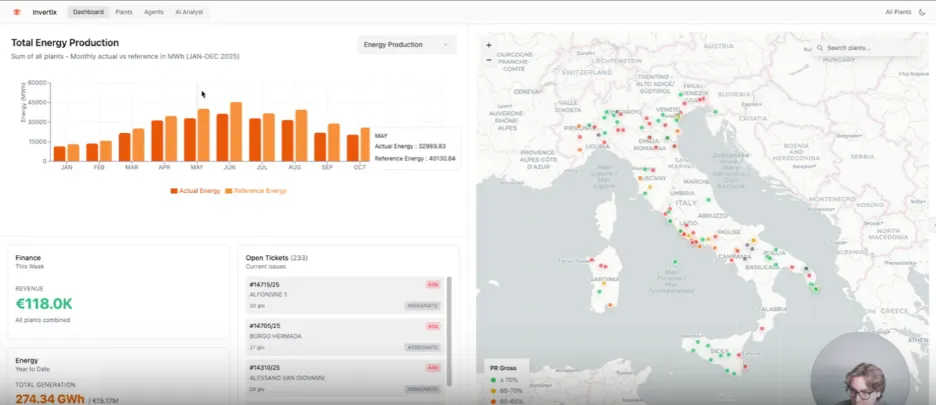
Invertix is the single platform where ops teams move from chasing data to executing decisions. The architecture has three components:
Unified Data Layer: Pre-built connectors for SCADA, O&M tools, metering, finance, and weather data, designed for messy, incomplete, vendor-specific formats. All data is ingested and normalized into a single standardized model, with full auditability so users can always trace why a number looks the way it does.
Agentic Analysis: Four specialized AI workers, a Performance Detective (anomaly detection ranked by revenue impact), Ops Dispatcher (enriched ticket creation with context and deadlines), Reporting Analyst (automated reports in client templates), and Contract Assurance Manager (clause monitoring and evidence pack generation), operate simultaneously on every event, providing the equivalent of a real-time internal data team.
Proactive Intelligence: A natural-language chat interface allows ops teams to drill into root causes across the entire portfolio with the AI flagging inefficiencies and technical anomalies before they become financial losses
The market
The global market for energy operations software is estimated at €25B (TAM), driven by the exponential growth of renewable capacity, increasing complexity of hybrid portfolios (solar + wind + BESS), and regulatory pressure to demonstrate operational efficiency to lenders and regulators. Invertix's initial beachhead is Italy. Italy is the most attractive European entry point for several structural reasons:
Italy has the highest density of independent renewable asset managers in Europe, approximately 150 companies managing between 10 MW and 2 GW each, too large to rely on Excel but too small to have built internal data teams.
The Italian market is structurally underserved: no dedicated AI operations platform exists for this segment. Legacy players offer basic monitoring dashboards but no intelligence or cross-system integration.
Invertix has secured anchor customers at the apex of the Italian market, generating inbound pull from the rest of the ecosystem through reference selling.
The market timing is particularly strong. Four macro forces are converging:
Decreasing government subsidies are forcing asset managers to optimize OPEX and recover every basis point of revenue, Invertix’s ROI case has never been more urgent;
Grid & BESS Complexity: storage and dynamic grid requirements mean more data flows and more technical failure points than ever, directly increasing the operational complexity that Invertix is designed to manage;
The rise of AI-driven data centers is raising the premium on renewable uptime and operational efficiency;
Large language models and agentic AI workflows can now credibly automate the heavy lifting of manual data analysis, making Invertix’s product technically feasible in a way that was not possible two years ago.
…And more!
What made me build conviction very fast is watching some of the largest players in the energy space in Italy become early customers/co-developers of the Invertix platform. One of them saw their reporting cycle reduced from 1 month to 15 minutes. Talk about an efficiency gain!
Remember the 300 people Joseph talked to? A few became angel investors in Invertix, further proving to us the fact that this is a large opportunity and the right team is building it.
Vireo Ventures, the energy-vertical fund that co-invested with us, is another strong signal: after meeting Joseph and Kaan, their partner Felix moved with incredible speed, and gave them a term-sheet in a couple of days. And I love, LOVE, working with Felix!
To the Invertix team: Congratulations on this first milestone. I can’t wait to see what you will create in the coming years. It’s early days and there’s much to build, but at IFF we believe in you and are proud to have you as a portfolio company.
- Ire
Thanks for reading Italian Founders Fund's Substack! Subscribe to receive all our future posts