Learning 1: Always remember to chase =)
We met HeyDiga because I was reminded, once again, of one of the most important lessons in venture: always chase :)
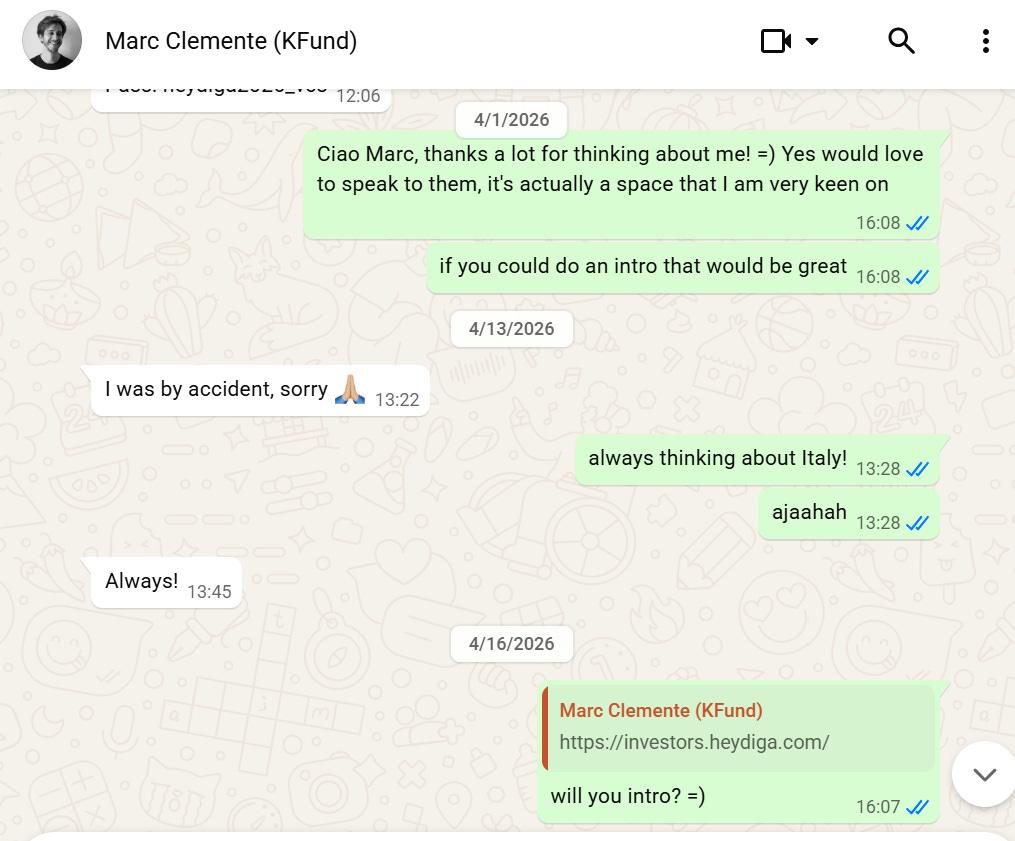
We are lucky to have a very clear angle at Italian Founders Fund. We invest from pre-seed to Series A in companies with an Italian DNA: born in Italy, expanding into Italy, or founded by Italians anywhere in the world. It is a simple mandate, but a surprisingly powerful one, because it gives people an immediate reason to think of us when they see something that fits. In early April, my friend Marc from K Fund pinged me saying he had “a nice deal for us”: one of their companies was raising a seed round and expanding from Spain to Italy. I accepted (spoiler 1: I love the voice AI space). A few days later I realized we did not speak yet so I sent a reminder.
That’s how I met David and Sergio from HeyDiga
Subscribe to receive more of these! :D
HeyDiga is building an AI agent for service businesses: the layer that answers calls, WhatsApps, and chats when the team cannot. It books appointments, answers questions, captures leads, and turns conversations into structured data for the business owner. In practice, it is trying to become the AI front office for salons, clinics, dealerships, restaurants, and every business where messages and calls are heavily used.
So, well, of course, the first thing I asked was to test the product. Who has not got angry after trying to call their hairdresser to book something? (I have, probably 100+ times). I opened WhatsApp and called the number they had shared with me. I wanted to reschedule my haircut. The agent replied SO naturally. I asked for a different time. It paused for a few seconds, and then I heard the sound of typing on the keyboard (the system was calling an LLM, checking availability, understanding intent, deciding what to do next). The “typing” was not a human typing. It was product design hiding latency. But it felt so real I really smiled. The demo still had small pauses, small imperfections but it was already good enough that my brain fully accepted (and loved) the interaction. After 1 minute on the phone I even received a confirmation via WhatsApp, and it really felt like I was texting someone who worked at the salon. Spoiler 2: everyone loves getting their problem solved in a fast and efficient way.
I thought: “ how cool is working in VC?!”. But now, let’s start with the actual due diligence on why now, why them, why us, why this and more generally just why.

Learning 2: back the teams that make you feel the pace
There are companies where you ask a question and get an answer three days later. There are companies where you ask a question and get a thoughtful answer the next day. And then there are companies where you ask a question and, two hours later, you get a detailed report, with usage breakdowns, customer cohorts, minutes, calls, vertical splits, and the feeling that the founders are not preparing data for investors but actually running the company through it.
HeyDiga felt like the third one. David brings product instinct. He started very young in design and product, worked at McCann, became the first product designer at Tuenti, the “Spanish Facebook” later acquired by Telefonica, then joined Jobandtalent as first product designer and founding team member. After that, he led product at Hawkers during its crazy e-commerce growth and later ran Storybeat, a photo and video editing platform with 20M+ downloads.
Sergio brings the technical depth. He was CTO of Jobandtalent for 9years, helping scale the company from a small team into a Spanish unicorn valued at $2.4B, growing the engineering team from 5 to 150+ engineers and building the infrastructure behind a marketplace operating across multiple countries. Before and after that, he built and advised technical products across AI, computational linguistics, marketplaces, and vertical software.
As you can expect, when the team is bringing this level of experience, their pace of execution is remarkable. In fact their internal setup feels closer to a team of humans surrounded by agents than a traditional startup with “AI tools”. Agents help qualify leads, book demos, prepare onboarding, generate tasks, surface customer insights, and push information back to the team. They have agents connected to their workflows, their tasks, their customer conversations, their product feedback loops. A customer asks for something, and the system can help turn that into a task, move it through the right internal flow, and get it closer to production.
A phone that no one picks up
Let’s start with the problem. There are over 26 million small businesses in Europe. Almost every one of them takes calls. And a ridiculous amount of those calls are missed, answered too late, answered badly, or answered without leaving any data behind. A beauty salon receives c. 80 inbound inquiries a day while two stylists are heads down with clients and nobody can pick up. A car dealership loses a potential €30,000 sale because the customer called once, reached voicemail, and then called the next dealer on Google. A clinic has a patient waiting fifteen minutes on hold. The patient gives up. The clinic never knows why. Yep, it’s true: every missed call looks small from the outside. You might think “oh, it’s only one booking, one appointment, one request, one lead..” But what about the power of compounding? One missed call is small. Hundreds of missed calls every month are not.
The back office of European service businesses has been digitized for years. Beauty salons have Koibox, Treatwell, Booksy, Panema. Clinics have Docplanner, Clinic Cloud. Dealers have Carbeat, Nextlane, and other vertical systems. Restaurants have CoverManager, Zenchef, TheFork, etc. The software is often already there. But the front line, the actual customer conversation, is still mostly analog:
A phone rings > Someone is busy
A WhatsApp arrives > Someone forgets
A message comes at 11pm on a Sunday > Nobody answers
The result is very simple: businesses lose revenue, teams get interrupted all day, customers lose patience, and owners fly blind. And when I say “fly blind”, I mean it very literally. Many of these businesses do not know how many calls they miss, when they miss them, what customers wanted, how many bookings were lost, how many people asked for a service they do not yet offer, or how often the same question is asked again and again and again.

Why now
The idea of an AI receptionist has existed for years. The reason it did not work before is also simple: it was too expensive, too slow, too robotic, or all three.
What changed is that, in a very short period of time, the economics and the user experience crossed the threshold at the same moment.
Voice AI became good enough
Voice AI became cheap enough.
And Southern Europe already had the perfect communication layer: WhatsApp.
In Spain and Italy, WhatsApp is how people book haircuts, ask restaurants if they have a table, message clinics, send documents, change appointments, send voice notes, and generally run half of their lives. At the same time, the cost curve changed. A human interaction can cost €7 to €12. An AI voice call can now cost a fraction of that (cents per conversation). And latency changed too. Voice AI used to feel like a bad IVR menu wearing a nicer jacket. You would speak, wait, hear something slightly wrong, get annoyed, and press zero repeatedly hoping for a human. Now the pause can be short enough, and designed well enough, that the interaction still feels natural. Sometimes the trick is infrastructure. Sometimes it is model routing. Sometimes it is a tiny typing sound that makes your brain accept the pause. The magic is not that latency disappeared. The magic is that the product makes it acceptable.
What they actually built
At the simplest level, HeyDiga answers every customer conversation. Phone, WhatsApp, chat. Day, night, weekend, holiday. The basic promise is almost childishly simple: no customer should disappear just because nobody was free to answer.
But the product becomes more interesting when you look at the layers.
The first layer is the agent itself. SONIA answers inbound calls and messages, understands what the person wants, and does the job: books an appointment, changes a booking, answers FAQs, captures a lead, routes the conversation, sends a confirmation.
The second layer is the business context. The agent is trained on each client’s services, opening hours, staff, prices, availability, brand voice, and workflows. A salon does not speak like a clinic. A clinic does not behave like a dealership. A dealership does not route a lead like a restaurant handles a reservation.
The third layer is the intelligence layer. And this was, honestly, one of the parts I liked the most. HeyDiga turns every conversation into structured data (and who doesn’t love data well used?!). For the first time, a business owner can see how many calls were missed, when they were missed, what customers were asking for, which services were requested most often, what customers complained about, what could be automated next, and what revenue was probably lost.
One thing I have learned is that the best SMB products look almost stupidly simple from the outside.
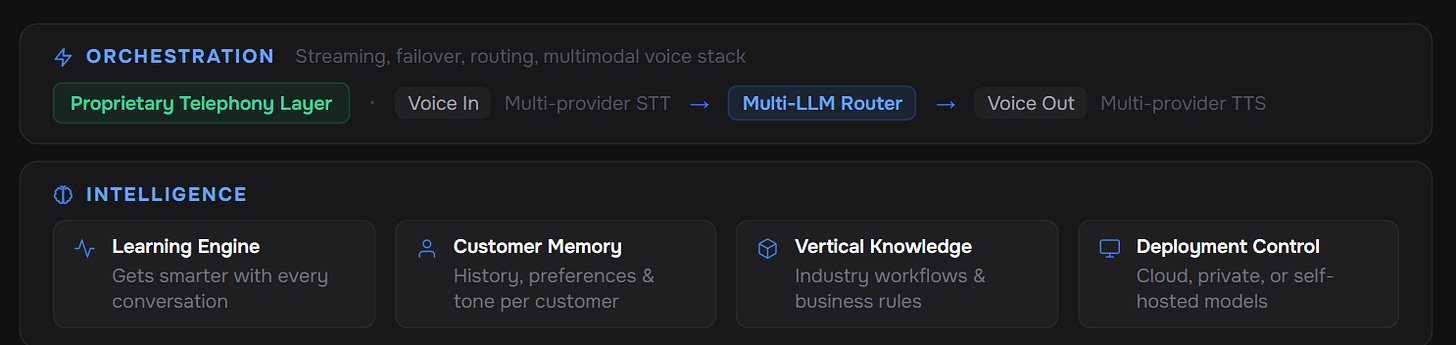
This is usually because all the complexity has been hidden very well. A salon owner does not care about STT, TTS, LLM routing, fallback chains, hallucination detection, latency monitoring, PBX integrations, or whether the system is one model behind the frontier because the newest version made the conversation slightly worse. They care that when a customer calls, someone answers correctly. Under the hood, HeyDiga has built a multi-provider orchestration layer across speech-to-text, large language models, and text-to-speech providers. The system routes across providers, monitors latency, detects issues, and can switch when something degrades. The production-grade, verticalized, phone-system-integrated, multilingual, multi-channel, low-latency, SMB-friendly, no-IT-required workflow layer is not easy at all. A lot of incumbents underestimate this. It is very tempting for a CRM to say: “we will just connect ElevenLabs to our software and ship an AI receptionist.” But that is not how production works. You need the telephony layer. You need fallbacks. You need CRM integrations. You need vertical vocabulary. You need routing logic. You need escalation. You need monitoring. You need to know when to answer, when to transfer, when to ask for clarification, and when to stop being clever and let a human take the call.
Learning 3: horizontal is not generic if the workflows go vertical
We debated this a lot internally.
In vertical SaaS, the instinct is usually: pick one vertical, go very deep, dominate it.
And there are good reasons for that. Vertical depth creates workflow ownership, distribution advantages, better integrations, stronger retention, and a product that feels native to the customer.
So the obvious question was: why is HeyDiga going across beauty, automotive, healthcare, hospitality, real estate and more?
Shouldn’t they just pick one?
HeyDiga is not horizontal in the sense of being generic. It is horizontal at the infrastructure and use-case layer, and vertical at the workflow and distribution layer.
Across verticals, a very large share of the use cases are the same: answer the customer, understand intent, book, reschedule, remind, answer FAQs, qualify a lead, capture data, escalate when needed, report insights back to the owner. A haircut appointment is not the same as a clinic appointment or a car service appointment. But structurally, there is a lot in common. The last 20–30% needs vertical adaptation: the vocabulary, the workflows, the integrations, the business rules, the tone, the edge cases. But the core platform compounds across every vertical. A reminder for a haircut becomes a reminder for a clinic appointment, a vehicle status update becomes an order status update, a customer satisfaction survey after a beauty appointment becomes patient feedback after a clinic visit, a lead qualification workflow in automotive becomes an inquiry qualification workflow in real estate. The horizontal-first approach makes sense here. Each vertical adds volume, data, infrastructure learning, cost advantages, and new use cases that can often be reused somewhere else.