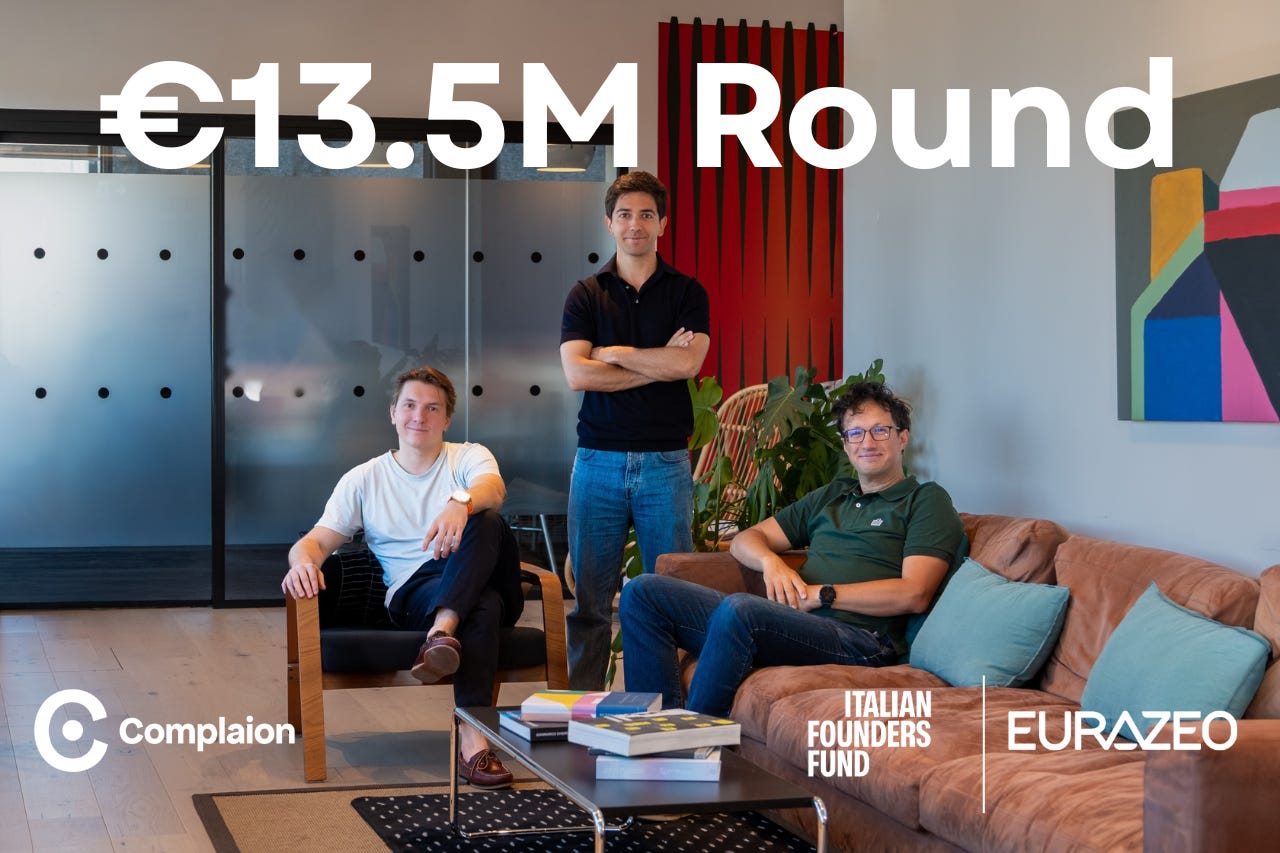
So much venture capital news tends to highlight the big picture: amount invested, funds involved, what the company does, a blurb or two from the founders. That’s ok for getting a bit of buzz, but it doesn’t really help the coming crop of founders understand what it takes to get to that point. I want to give a closer look at what makes an investor - me, and more broadly, Italian Founders Fund - say, “Yes, I want to invest in this company.” Luckily, we have a number of portfolio companies to work with. Today, I want to tell you about Complaion.
Subscribe to get more behind the scenes on our investments!
A team
Back when the European startup market was really starting to develop back in the 2010s, a kind of “entrepreneurship school” sprang up. The Rocket Internet world, based out of Berlin, was launching and scaling European versions of products that were proving viable around the world. Some of today’s major European brands started there, including Zalando, HelloFresh and DeliveryHero. I had a front row seat for a lot of what was happening there, as Rocket invested in Zipjet and then I later became a partner in the group’s VC arm, Global Founders Capital.
Because Rocket’s niche was quickly building on ideas that had been validated elsewhere, the key value was execution: fast, efficient, managed execution. That made it an incredible place for people who knew they wanted to be entrepreneurs, even if they didn’t necessarily know what they wanted to build.
(That’s not every entrepreneur, of course. The reasons for getting into startups and entrepreneurship are as varied as the companies out there, and in my years as both an entrepreneur and investor I’ve come across pretty much every type of founder out there. All of them can succeed (and fail!), whether taking a Rocket-style path or not.)
With Rocket Internet’s emphasis on execution and management, it isn’t a surprise that one of their key recruiting avenues were the major consultancies, and in particular McKinsey. Even back in the middle of it all, if someone was paying attention, it’d be quite easy to see just how many Rocket founding teams involved someone with McKinsey experience.
Edo from Complaion was paying attention. As he tells it, he always knew he wanted to be an entrepreneur, and realized that one fast track would be to go the McKinsey route, with an eye to being recruited by Rocket. That’s what happened, and it’s also how our paths crossed.
During my time at GFC, I was on the board of a company called Katoo - the Rocket company that Edo ended up in. Edo and his now co-founder Marco were managing Italy for Katoo, and they were very highly regarded by everyone at Katoo. In the end, like so many other companies that were caught in the strange years just before, during and after COVID, Katoo closed. But Edo and Marco knew they wanted to build something together, and knowing their reputation, I was happy to hear about what they were doing.
A market
But here’s the thing: an investment is a lot of different pieces, and they all have to come together. When Edo and Marco were raising for their new venture - PartApp, offering fractional home ownership for vacation homes - IFF was up and running… but we passed. Because while we absolutely loved the team, we weren’t convinced about the market opportunity.
Edo and Marco worked for about a year, and then came to roughly the same conclusion themselves, that the path they were on wasn’t the right one. They offered to give the money they’d raised back, but most of their investors were interested in them as a team, meaning they were perfectly happy to have them explore different options. Long story short, weeks of whiteboarding and market analysis led the team to something extremely interesting, and Complaion is the result.
There aren’t many markets in which Italy is a true global leader, beating out virtually all others, including the USA, UK, India, Germany, France. But Edo, Marco and their new co-founder/CTO Ale found one: the market in ISO certifications, an international standard that is both hugely important (as it opens the path for businesses to expand their viability and reach) and hugely time-consuming (as it’s a regulatory process based on mountains of paperwork and documentation).
What’s more, ISO compliance is a market that isn’t flooded with competitors, whether historical players or startups. It’s not because the market isn’t ready for what tends to be called “disruption”; it’s because of something else Edo put right up front in the first Complaion presentation he sent to us at IFF:
It’s boring.
That in itself serves as a kind of barrier to entry for lots of entrepreneurs. If people get into startups for the headlines, or the “changing the world” rhetoric, or because it’s a pain point they’re feeling personally, ok, great. Like I said earlier, entrepreneurship comes in all shapes and motivations, and people can find success with all of them.
But ISO certifications don’t really fall into any of those common categories. Yet it’s a market that on national, regional and global scales is important and massive, and one where Europe’s undisputed leaders are Italy and Spain.
A problem
By their very nature, ISO certifications are bureaucratic processes, with both original certification and renewals heavy on documentation. They’re also critical to a wide variety of businesses, from major corporations to SMBs, as they’re part of what can open - or close - particular markets to a company’s products. Millions of companies worldwide either depend on their ISO certifications or need them in order to open up revenue opportunities.
But just to give you an idea of the level of work involved, each yearly ISO audit can involve 300+ pages of reporting. That isn’t just a person writing a report: it’s an ongoing set of interactions, data gathering, drafting, feedback and editing… And that’s the case no matter if you’re a SMB or a major corporation - both of which have procedures and hierarchies that create certain advantages and problems within the whole process.
The diversified nature of the ISO market and what it takes to earn and renew certifications means that much of the current industry is divided among an army of outside consultants, some of whom are very good at their jobs, and some of whom are not. That army grew up because, while ISOs are technically “standards”, lots of edge cases pop up. Navigating it all requires real expertise, not just filling in forms.
A product
Those complexities are why Complaion is being built at the right moment, as the ISO compliance market and needs are very well-suited for what can be assisted by today’s AI - which, notably, doesn’t mean an “automate everything!” approach.
By reducing the time and cost of significant amounts of paperwork, combined with more efficient document handling, Complaion is able to provide more room for expertise. They ensure quality control with human-in-the-loop thinking, using ISO experts to ensure that the 80% that can be automated is done right, and the 20% that can’t be automated is done right as well. The end result is completing the certification requirements in a matter of weeks, whereas traditional timelines were measured in months.
No wonder they’re enjoying an NPS score of 90+, while also hitting 5x YoY growth!
Plus, Complaion has the benefit of being a “land and expand” product: ISO certifications are just one part of a set of interrelated business needs, ranging from health & safety compliance to GDPR and even security tests. By gaining customer confidence alongside detailed knowledge, they’re moving fast to expand their offer, bringing messy, burdensome processes into their streamlined dashboard.
An opportunity
For me, once Edo, Marco and Ale came back to us with their pivot to Complaion, it really was a no-brainer for IFF to invest. Because even as the product was still in its early stages of development, it was clear that they were excellent founders who were pointing all of their energy at a problem - and a market - that could prove extremely rewarding.
So just like with JetHR, the pieces had to come together in their own time. Managing those pieces is one of the hardest things in venture, which is premised on the idea of nailing the timing of an investment (being early is the same as being wrong, chasing the pack means vastly diminishing returns, etc.): maintaining discipline in a world driven by excitement and possibility, and then knowing when it’s time to take the leap with the right people.
Big congrats to Edo, Marco and Ale for this milestone. This is just the beginning.
-Lorenzo