I was a happy Instacart customer back in San Francisco. Then a happy Everli customer when I moved back to Italy. I love them, they save my life, but I also know how operationally brutal they are to run: thousands of suppliers, hundreds of thousands of SKUs, a catalog that has to make sense to a shopper who is one tap away from a competitor (sorry but when I don’t find something I just jump to Esselunga). Get the catalog wrong and nothing else really matters. Ciao ciao.
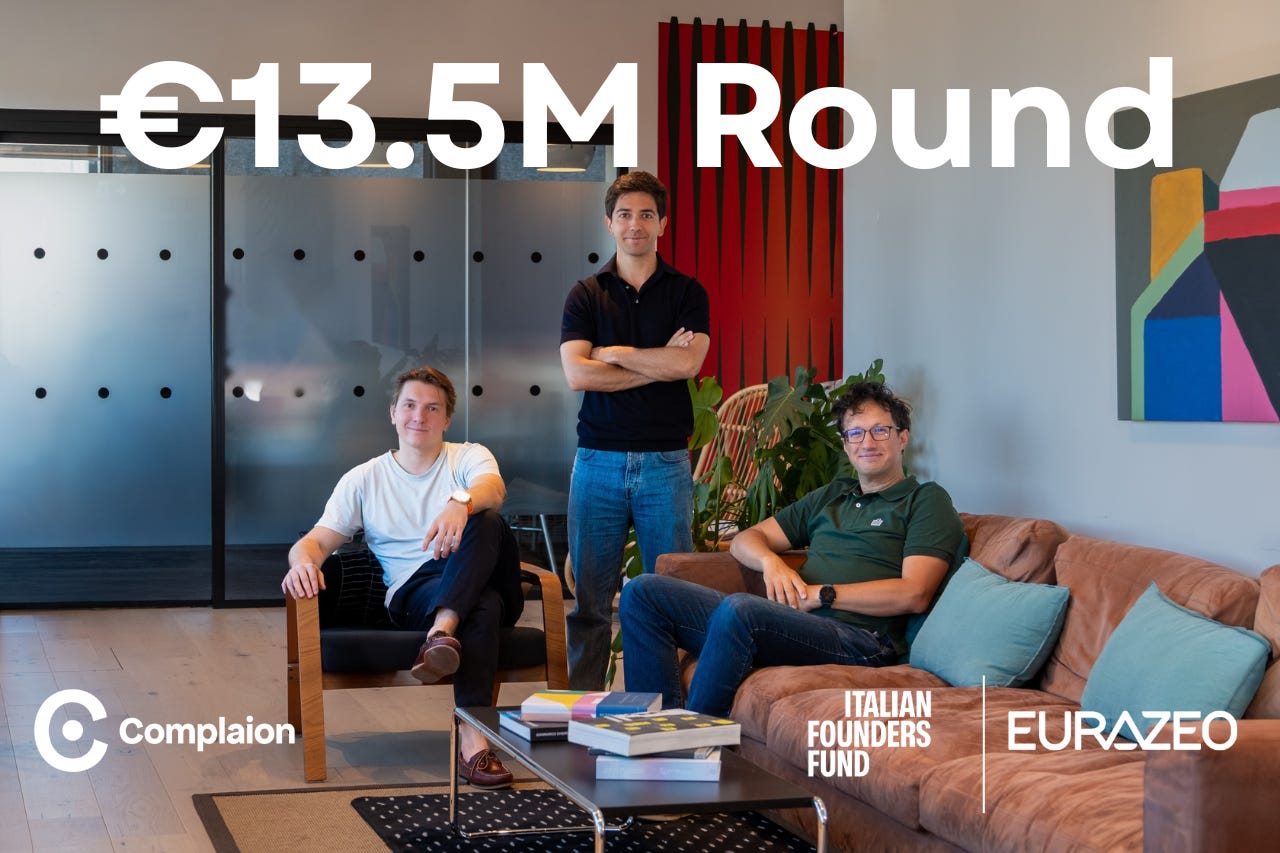
When I first heard that amazing founders like Federico, Daniele, and Alessandro, were building CommerceClarity I knew it was the right match. They know this problem and this space so so so well. Fede scaled Everli from €1M to €150M in GMV and spent years before that launching Amazon verticals in Italy and Spain on a €3B+ P&L. Ale ran Everli’s finance and operations alongside him for seven years, from 10 people to 300. Daniele bootstrapped a D2C electronics business to €30M in revenue on his own. They know exactly where the hours go, what breaks at scale, and why the older solutions never quite worked. Now building the solution they each wish they’d had (and I’m a very grateful customer of their customers!).

The problem
If you walk into a serious catalog team at a European retailer today, what you find is very high-value work running on very old rails. The data that describes a single product lives in five places at once: in the ERP, in the PIM (Product Information Management, the system that centralizes and manages product data for distribution to sales channels), in a DAM (Digital Asset Management, the system that stores and organizes media files like images and videos), in an Excel file the buyer maintains, in a technical spec sheet sent by the supplier as a PDF. Half of it conflicts with the other half. Before a new product can go on sale, somebody has to find all five sources, reconcile them, fill the gaps, translate them into the retailer's voice, adapt them to every channel that will list the product, and verify that nothing breaks a brand rule or a compliance requirement. That work takes weeks and involves multiple people.
The category manager has a spreadsheet open to fix a product title that Amazon rejected for being three characters too long, and there are forty thousand more like it in the queue. A pet retailer publishes a product flagged "vegan" with collagen in the ingredients, and the flag arrives via a customer complaint, not the team. A grocery brand updates a packaging spec in the English master and twelve months later twelve of thirteen local sites are still running last season's claim. Two things follow. New products reach the shelf weeks late, with information that is incomplete or wrong. Operational cost is structurally too high, and revenue that should have been captured is left on the floor.
The catalog is the asset that everything else rests on: marketing pays to drive traffic to it, retail media monetizes against it, AI buying agents read from it to decide what to recommend. And the infrastructure running it looks like accounting software from 2005. Aiuto.
Why now
Three things converged in the last eighteen months that make this the right moment to build. The first is cost. Reading a messy supplier feed, mapping it into a retailer’s taxonomy, generating channel-ready content in the right brand voice used to cost €5–50 per SKU in human time. It is now cents per SKU. CENTS!
The second is what the models can actually read: a catalog is text + images + PDFs + packaging photos + regulatory documents, and two years ago only the text was machine-readable. Now you get the full package 📦
The third is the new interactions with the catalog. McKinsey projects €3–5 trillion of retail spend mediated by AI agents by 2030. 74% of Italian consumers used a GenAI tool to research a purchase in the last three months, the highest rate in the EU-5. 20% of global e-commerce orders during Cyber Week 2025 were already influenced by AI agents. These systems don’t browse like we do, they query. Only products with structured, accurate attributes get surfaced (and sell!). Products without them go invisible (and die!). The retailer who waits until 2028 to fix their catalog has already lost the channel (and years of work!).
What CommerceClarity is building
Sierra built the agent platform for customer service: vertical, opinionated, operator-credible, and now worth $15.8B at the May 2026 Series E, serving 40% of the Fortune 50. CommerceClarity is building the equivalent for the catalog, arguably an even more foundational layer because everything that gets sold in agentic commerce gets sold through it.
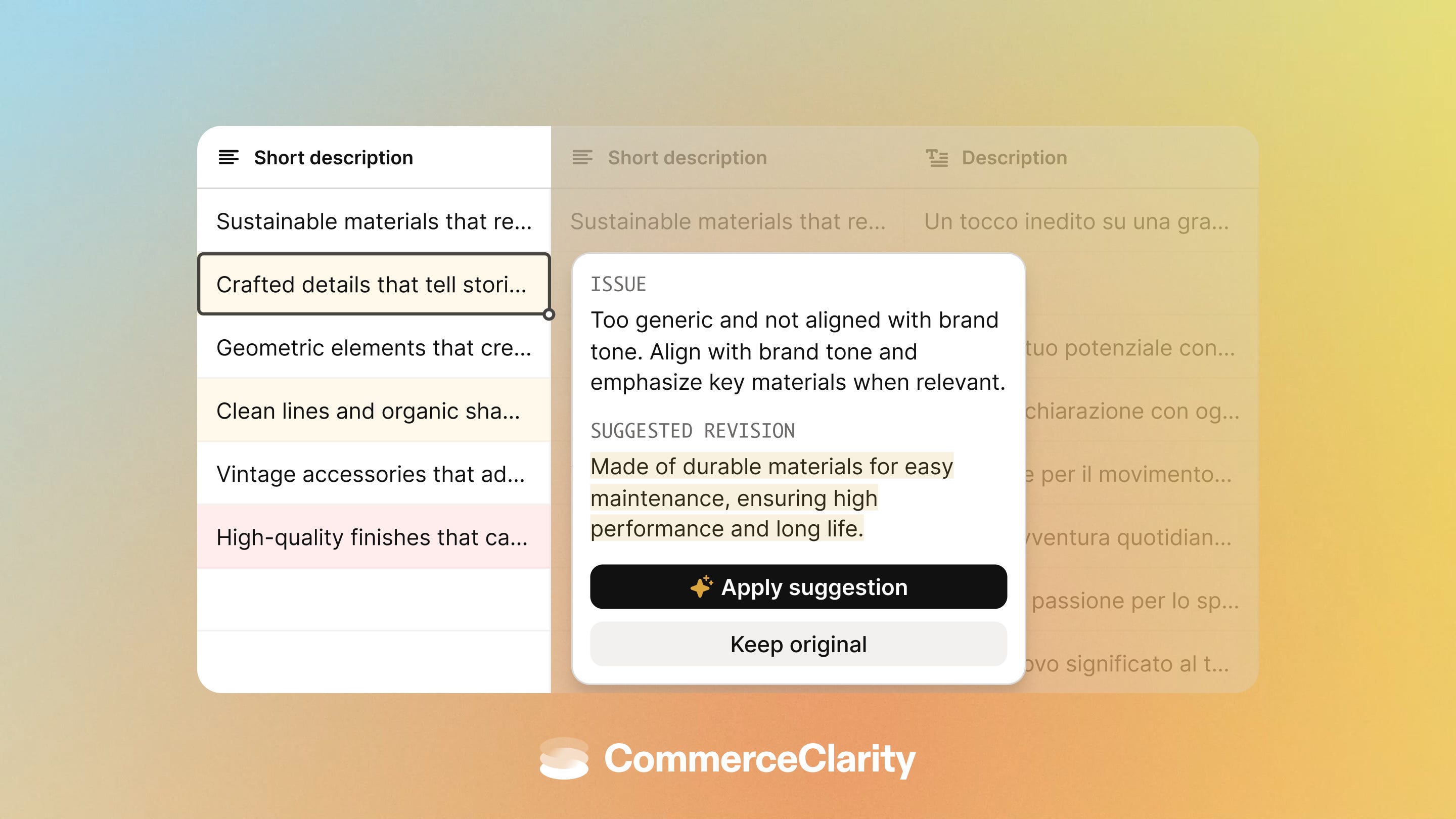
The platform reads from whatever the retailer already has: PIM, ERP, DAM, supplier feeds. None of those systems change. It applies the retailer’s brand voice, taxonomy, channel rules, and regulatory requirements as a governance layer, then generates channel-ready content for every surface: the e-commerce site, every marketplace, every market, every AI-buying interface. And it shows you exactly what changed, by which rule, and from which source. The right way to think about the PIM question that always comes up: Akeneo stores, CommerceClarity reasons. It sits on top of the PIM and works with what the retailer already has.
The market is already (very!) there
Sequoia published a piece earlier this year called Services: The New Software. The core idea is that for every dollar companies spend on software, six go to services, and the cleanest entry point for an AI autopilot is work that is already outsourced, because the budget line exists and the substitution is frictionless. Catalog operations is exactly that. Content agencies, translation agencies, SEO consultants, marketplace specialists, image production studios, merchandiser headcount: this is where the real money has always been going. When an enterprise retailer moves to CommerceClarity, the budget the platform steps into is the services budget, the one that has been growing quietly for years. Stiga is the clearest example: four agencies, one per marketplace, one per country, three to four years of work, compressed into three to four months with one dedicated person. The opportunity is as large as the work that has been done manually for decades (which turns out to be very large indeed).
The Luca Cozzolino Inevitable But Nonetheless Satisfying Convergence
Six weeks ago, CommerceClarity closed its first acquisition. Luca Cozzolino, formerly product at Shopify and Zalando and an ex-merchant himself, had been building Katalogo.ai in Barcelona: a point solution that uses an agent as a stylist to turn the catalog into looks designed to sell together. Same problem space, same conviction, different shape.
Luca and Daniele met for a coffee in late 2025 that turned into a five-hour conversation. By the end of it both had reached the same conclusion: Katalogo’s agent belonged on a platform like CommerceClarity, not next to it. Shortly after that Luca joined CommerceClarity as Chief Product Officer 🎉
That move clarified something important about where the moat actually is. The companies that win this layer won’t be the ones with the best model (the model is the same model anyone can call). The winners will be the platforms with the operator credibility to sell into enterprise retail, the depth to configure against each customer’s specific rules, taxonomies, and compliance constraints, and the per-merchant memory that accumulates and compounds week by week. Generic AI tools can’t do that, point solutions can’t do it at scale. When someone with Luca’s background, building the same thing independently in Barcelona, decides the platform play is the right answer, that’s the market telling you something worth listening to.
The team
Each of them has done a version of this before.
Federico Sargenti, co-CEO, scaled Everli from €1M to €150M GMV, raised €80M across tier-one rounds, launched Amazon verticals in Italy and Spain on a €3B+ P&L, and co-founded Witailer, which exited to Retex.
Daniele Vella, co-CEO and Chief Product & Growth Officer, bootstrapped a D2C electronics business to €30M in revenue and conceived and coded the CommerceClarity MVP.
Alessandro Angelini, COO and CFO, spent seven years scaling Everli’s finance and operations alongside Federico.
Michele Sampieri, CTO, is a repeat founder who previously exited a travel-tech startup and built an energy-commodity forecasting platform.
And Luca Cozzolino, CPO, former product at Shopify and Zalando, ex-merchant, founder of Katalogo.ai.
Five people who have each already felt the pain they are now solving.
Come on, this is the kind of founding team where the only interesting question left is how large this becomes 🚀
So now what?
Forty enterprise customers in eighteen months: Nestlé Purina, Prada, Cisalfa, Arcaplanet, Stiga, 1000Farmacie, Atida-eFarma, Chicco, Scalapay and more across grocery, pet, sport, pharma, home care, electronics, and fashion. Best numbers from live deployments: 90% reduction in catalog cost, 30% sales lift on optimized assortments, 8x faster time-to-market (and customers who land on one agent are already asking for the next one).
Ten years from now, the idea that retailers managed the foundation layer of agentic commerce with spreadsheets, agency cycles, and email threads will look absurd.
Giusto?
To Federico, Daniele, Ale, Michele, Luca, and the whole CommerceClarity team: the catalog is in good hands. LFG 🛒⚡️