Albi here! Over the past few months, I talked to dozens of ambitious students who want to work in a startup. First of all, this is super cool. One of the things I care most about is having the youngest and brightest work on the frontier of technology, building the future. Most of the time, the future is built in startups, rather than big corporations. Of these students that I talk to, many want to build their company one day. That’s a great reason to decide to work inside a startup, as it’s the closest thing to being an entrepreneur yourself (especially at the earlier stages).
For people with a generalist background who want to become founders, there’s one role that rules above them all: The Founder Associate. And there’s good reason for it: you sit next to the founder and see everything happening inside the company, take on a lot of responsibility and see many different aspects of company building. But I still feel like there’s a lot of confusion about the FA position: it’s often just an executive assistant role in disguise, and for many there might be better options in the magical world of startups.
This article is my attempt at answering the question: “What does a Founder Associate actually do?” and help you understand if it’s the right job for you. To do that I will draw upon anecdotal evidence from many of my friends who work in startups, and testimonials from two killer founder’s associates: Alessandro Lombardo and Francesco Rosa. Disclaimer: You’ll see that their actual positions are listed, respectively, as “Operations” and “Chief of Staff”. For the sake of simplicity throughout the article I will be referring to the role as Founder Associate, but what I’ll be writing will be true for any generalist job at a startup (i.e. Operations, Founder’s associate, Chief of staff will be used interchangeably).
Subscribe for more articles like this!
What a Founder Associate does, on paper
The simplest definition I can give of a Founder Associate is: someone that takes care of everything that shouldn’t be in the founder’s hands. You are the right hand of the founder, and you are expected to help them on whatever is their current bottleneck. This can mean many things:
reaching out to 100 companies to invite them to an event that your startup is organizing
hiring for the new head of growth: reaching out to interesting candidates, interview them and then make a shortlist of the best fits
preparing a pitch for investors to raise the next round of funding
automating a customer onboarding workflow
…The list goes on. Sometimes, you can do all of these in the span of a week. Other weeks, you might find yourself only doing customer discovery calls because that’s what’s most important for the business. The point is: the Founder Associate role can change a lot depending on the startup, the domain expertise of the founder, the stage of the business, and other circumstances. Your job is to fill gaps, and gaps are dynamic. Cool right!? Not so fast, cowboy. While the role sounds fancy, many times a founder’s associate is just a glamourised executive assistant, or a BDR in disguise.
Why you should (not) be a Founder Associate
A startup usually only needs one Founder Associate, even as it scales. This is not true for sales roles. As a startup grows, it will need more BDRs and Account Executives. So there’s a lot of people who want a FA job, but way fewer FA jobs than BDR jobs (guess that’s also part of what makes it cool). I’m gonna say something groundbreaking. BDRs are more useful than founder’s associates. In fact, in an early stage startup, there are two things that are most important above all: selling and building. If you’re not selling or building the product, you are likely not as important to the business as you might think. So what I tell many people that come to me asking how to get a FA job, is: maybe you shouldn’t. You should probably become a BDR because:
There are way more BDR jobs (see above), so your chances of getting into a very high quality startup are higher (I argue that quality of the startup is more important than the role)
You are more important to the business ie you have the chance to prove yourself and grow very fast if you bring in results
Selling is one of the most useful skills in life, and certainly incredibly important if you want to become a founder (see below)
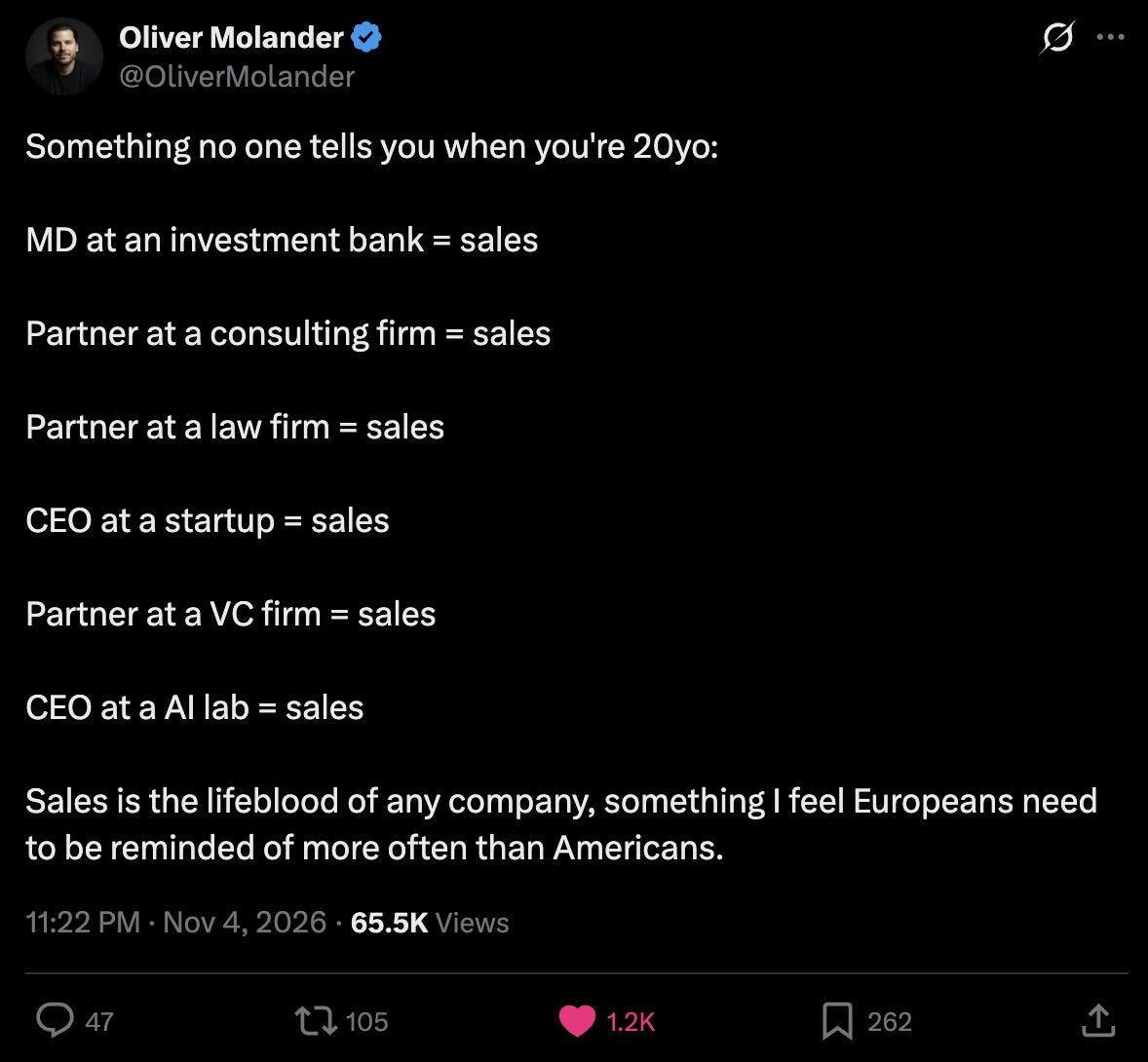
Don’t get me wrong, I still think the Founder Associate is one of the coolest jobs out there, but it might not be for you, and if you find yourself having to choose between a FA job at a Tier 2 startup, or a BDR job at a Tier 1 startup, I would always go for the latter. Quality of the team >>>> everything else.
But this is an article about the Founder’s Associate and I guess that’s what you’re here for, so in an attempt to shed some light on what this job can entail, I asked two friends to tell me about their experience.
Introducing Alessandro Lombardo, doing operations at Paradigma.
Alessandro Lombardo at Paradigma
Paradigma is an IFF portfolio company. It’s building infrastructure for autonomous research: teams of AI agents that run R&D for companies. If you’re curious to know more about them, I made a video with them with Unlinear.
The story of how Ale met Paradigma is quite funny. Some of you might be familiar with five degrees, the layer connecting the best European founders with the hungriest talents. At IFF, we did an event with them back in April. If you’re curious, here’s an article Irene wrote for the occasion (The operators revolution). Anyway, the founder of five degrees, Zoran knew that Paradigma was looking for a founder’s associate, and he immediately thought of Alessandro (who is also an IFF scout!), connected the two and boom: match made in heaven. A couple months later, Ale was moving from Paris to Rome (!!).
Ale has the perfect background for a FA role: he previously worked for edtech company Augment, where he started in Sales Ops, then grew into Growth Ops and Community Ops. Anything that needed to be automated, Ale was the man.
Why would a company like Paradigma want a generalist? They’re building an AI lab after all, and they are extremely product driven, only hiring researchers thus far. At the frontier, the product is 99% of the company: you win because your model performs better on benchmarks, not because your marketing is nicer. So Paradigma needed someone like Alessandro to take care of everything that isn’t research, and protect the researchers’ time.
He was the first non-technical hire, and the only business-side person in a technical team. In the day-to-day, his main activities cover budgeting, helping the founders with investor updates, planning the next round, strategy.
But the long-term part is where the sauce is. The company is brand new and light on operations, so he can set up processes from near zero. He’s building an operations layer that both people and agents can navigate. Basically a GitHub repo with two sides.
The first side is company context. It pulls from Slack, Linear, Gmail, Calendar and Granola. Any context the team can give has to end up in the repo.
The second side is self-feedback. Agents use that context to do tasks, for example handling communication with the company’s lawyers. Before a task is closed, a human checks it and gives feedback. The agent stores that feedback, so next time it doesn’t repeat the mistake.
Right now Alessandro spends a big part of his time giving feedback, because agents tend to do things in the way that is probabilistically optimal, instead of the way it needs to be done. The goal is an operations layer that improves and maintains itself, and eventually runs without a final human check.
In building this system, Ale was inspired by what Jack Dorsey is doing at Block. Dorsey argues that a company’s internal model of its own work can take over the coordination that management layers do today. If you’re interested, read Block’s essay on the topic: “From Hierarchy to Intelligence”
Francesco Rosa, Atlas Bio
Some of you might know Fra, he was previously a superstar at IFF, and we miss him dearly. He now works at Atlas Bio, a startup building foundational models for biotech and pharma.
Their team is small (10 people) but senior. Like Ale, Fra is the first non-technical hire. They are building something very technical and sell to big pharma. This is not your standard Saas startups. Tickets are big, the players are few and concentrated, and a mistake can burn one of the few contacts you have. “Move fast and break things” does not really apply here.
Fra’s starting challenge was to replace the two founders (the CEO and the CTO) on the boring, bureaucratic, repetitive work, and automate it as much as possible. First came accounting and reimbursements: design the whole accounting system, and fix a backlog where people had waited months to be reimbursed. In the beginning, Fra didn’t really have a complete vision on how the processes ran from start to finish. He learned that you can’t automate what you don’t understand yet. For the first two months he did things manually and slowly, on purpose, to learn how everything works. Then he started automating the processes.
Since then the job has spread across almost everything that isn’t product or sales:
People operations: contracts, permits, onboarding and equipment, so new hires can start from day one.
Finance and admin: rebuilt accounting and reimbursement processes, with agents that reconcile bank statements with the books and flag anything missing.
Compliance and external providers: anti-money-laundering checks, pension funds, taxes, and setting up new providers.
Internal communication: reshaping how information moves as the team grows.
Investor reporting: regular updates and ongoing contact, with the CEO still owning the relationships.
Launch preparation: the communication and recruiting channels the company needs to come out of stealth (which happened recently!)
Coming next: a commercial kick-off, where the time he saves by automating goes to branding and awareness among pharma executives (LinkedIn, lead generation, support on commercial strategy), then fundraising support, and organizing the team off-site. Two very senior sales people have just joined, so he stays out of the sales itself.
All very cool stuff if you ask me!!
Final thoughts
Hopefully after reading this article you have a better idea of what the role of the founder associate entails, but I would understand if you’re even more confused because the answer is: basically everything that needs to be done.
Becoming a founder associate can be one of the best training ground for future founders with a generalist background. It allows you to see many different parts of the company, learn what you are best at and what you like most doing. But there are many other roles that can train you to become a terrific founder, and you shouldn’t rule them out just because they don’t look as cool on your CV.
Thank you for reading this far, if you wanna work for some of the best companies with an Italian DNA all over the world, we have multiple openings across the IFF portfolio. Check them out here (not all our portcos job postings are here, so shoot me a Linkedin DM and I’ll do my best to connect you directly if you want to talk to a specific startup)
On we build,
Albi
