When we launched Italian Founders Fund, the pitch was simple: back companies with an Italian angle. That usually means Italian founders, wherever they are in the world, or startups building out of Italy. But there’s also a third category in our thesis, namely international companies where Italy is an attractive market for expansion. There are a number of industries where Italy’s large, under-digitised economy is a real opportunity; at the same time, it’s a geography where the success of a company’s move into the peninsula can depend on having the right local partners - like IFF and our entrepreneurial network of LPs.
Today we’re extremely excited to announce our participation in Sona’s $45M Series B alongside N47, Northzone, Felicis, Gradient, and Antler.
I first came across Sona over four years ago. Workforce management is not an abstract category for me (I once launched a startup in HR tech). So I have some experience with the opportunities involved, the gaps in the market, and the challenges in winning and keeping new accounts. And as soon as I saw how Steffen, Ben and Oli were approaching those topics with Sona, I wanted to get involved.
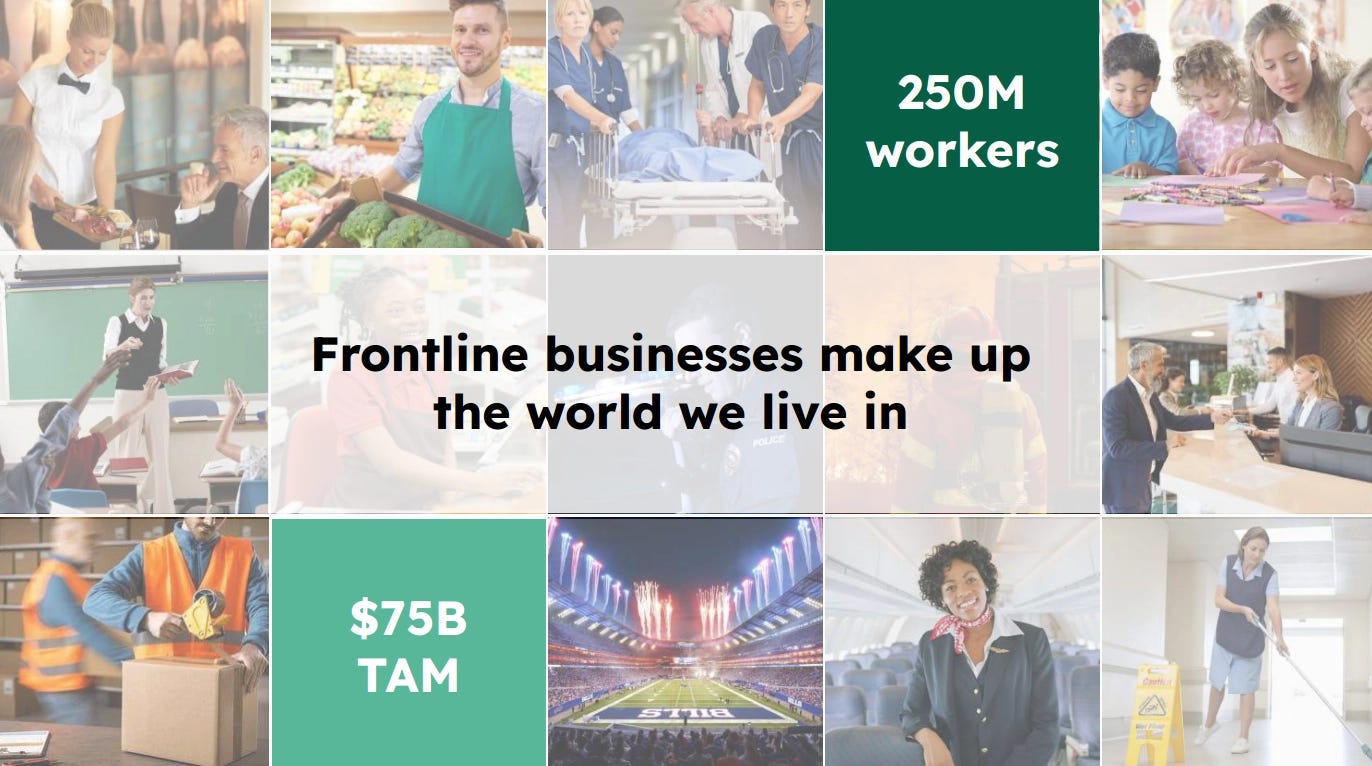
The world runs thanks to frontline businesses
Think about the last week of your life: Maybe you had a hotel stay? Dinner at a restaurant? Visited a loved one at the hospital? These businesses, with their wide range of activities, are all running on one thing: frontline workers. Each individual business is made up of people working shifts, across locations, in operational environments where being understaffed costs you revenue and being overstaffed destroys your margin.
In the Western world, frontline workers represent 55% of the workforce. Yet for decades the enterprise software world has almost entirely ignored them. This while white-collar HR solutions have sprung up everywhere, with aggressive battles fought over market share: Workday is now a $50B+ company; Rippling, the modern challenger, reached a $16.8bn valuation; Deel hit $17.3bn. Billions of dollars of value have been created by solving people-management problems for desk workers.
But what about the more blue-collar side of things? Why are frontline workers and the businesses that employ them still waiting to move away from Excel spreadsheets, or even pen-and-paper scheduling? The category is waiting for a leader, and that’s exactly what Sona is building.
Sona is an AI-native workforce management platform built for large, multi-location enterprises with frontline workforces. This includes industries as wide-ranging as hospitality, social care, healthcare, retail, even logistics. In these businesses, labour is the single biggest cost line and scheduling is genuinely complex: hundreds of locations, shift patterns, compliance requirements, and payroll details that have to be exactly right.
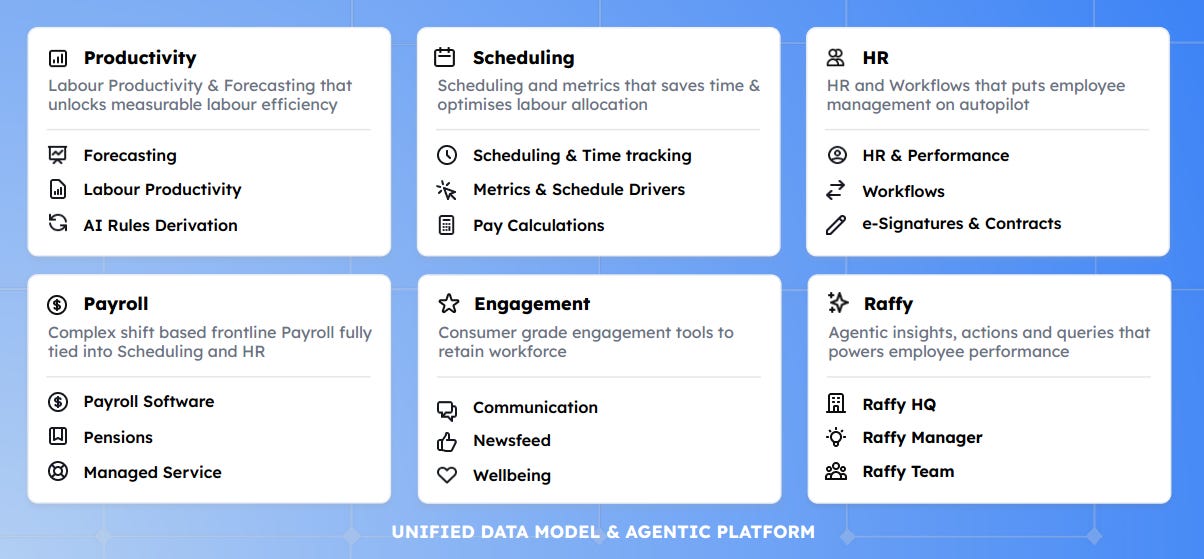
What sets the Sona team apart isn’t just what they’ve built - it’s how they did it. Competitors in the space have generally stopped at the SMB level, or have tried to bolt modern UX onto legacy architecture. But Sona’s cofounders decided to build an enterprise-grade solution from day one: a unified data model connecting scheduling, time & attendance, payroll, HR, and employee engagement into a single system of record. The result is that their customers are typically replacing between 5 and 9 legacy tools in one rollout, seeing measurable labour cost reductions show up directly on the P&L. It’s the kind of quantifiable benefit that makes the product incredibly sticky, with Sona clients consistently reupping with them over the long term.
An experienced team
It’s not a coincidence that Sona’s team was able to see a path forward that was fundamentally different from how others have approached this space. Steffen Wulff Petersen (CEO), Ben Dixon (CTO) and Oli Johnson (CFO) have been working together for a decade, but the story that brought them here is anything but conventional.
Steffen’s career began in investment banking at Goldman Sachs before he made the leap to Rocket Internet, where he built and ran Rocket UK. There, he led the launch of HelloFresh (now a public company worth ~€8 billion) and Payleven, which later merged with SumUp (now $10 billion+ valuation). From London, he then headed to Southeast Asia to scale Lazada across six markets (Indonesia, Malaysia, Thailand, the Philippines, Vietnam and Singapore), growing the business to over 10,000 employees and ultimately exiting for $3.2 billion to Alibaba. A recurring thread through all of this: frontline workers, at scale, and the operational complexity that comes with them.
That thread became the founding insight. Back in London, Steffen reunited with Ben and Oli to build Catapult, a marketplace for shift-based work, through which they employed 10,000 frontline workers directly. They didn’t just observe the chaos of managing large hourly-paid workforces, they lived it, and built the technology to solve it. By 2021, it had become clear that the real opportunity wasn’t in the marketplace layer, but in the infrastructure beneath it. Sona was born.
At IFF, we’ve been lucky to follow this journey closely. Lorenzo first met Steffen when they were both in the Rocket Internet universe (Lorenzo running Zipjet, Steffen leading Rocket UK) and they stayed in touch over the years. When Steffen shared Sona’s new direction and European expansion plans, it was immediately clear that Italy could be a key market in that story.
Ok, so why Italy?
Italy has one of the largest frontline workforces in Europe. Hospitality, healthcare, social care, food service, these sectors are the backbone of the Italian economy. Labour typically represents anywhere from 25-75% of operating costs in these verticals, yet the tools most operators rely on are still frighteningly basic. Some are using legacy hardware systems built (and pretty much never updated) in the 90s; others use Excel; some still just use a sheet of paper.
What’s more, these sectors are under serious pressure in terms of staffing, operations and costs. Italy’s ongoing demographic issues, both in terms of supply and demand, are adding stress to the system, which means optimizing workforce management is more important than ever before.
Despite those needs, we were also struck by the fact that the competitive landscape in Italy is almost nonexistent compared to the UK or US, as no credible next-generation WFM player has established a real foothold here.
Getting that foothold is also where Italian Founders Fund can provide more than capital. Our network of LPs gives us privileged contacts across Italy in the hospitality, healthcare, retail and services sectors - the exact verticals Sona is going after. That network can help open the first enterprise doors, support senior hiring on the ground, and navigate a market that moves differently from the UK. Plus, with our portfolio company JetHR tackling white-collar personnel management in Italy, the addition of Sona gives us exposure across the full workforce stack.
So we’re proud to have Sona become the second investment we’ve made in our “Italy expansion” investment category over the past few months (joining Netherlands-based Klearly). There will be more coming: Italy is a significant market that’s ready to adopt the right solutions. And IFF is building the network - and track record - to prove it.