Despite billions spent on health IT, roughly 80% of healthcare data remains trapped in unstructured reports, from radiology write-ups to discharge summaries. Meanwhile, about 70% of patients never return for their follow-ups, slipping through the cracks in a fragmented system. For hospitals, this isn’t just a clinical problem: it’s a business one, translating to an estimated 10% revenue leakage due to missed appointments and lost opportunities.
ReportAId grabbed our attention by aiming a generative AI lens at the pile of medical reports gathering dust in every hospital, turning that untapped text into actionable insights. In this article, we want to share the story of why we invested in ReportAId, and what we’ve learned from their journey so far.
The Hidden Gold in Medical Reports
Healthcare runs on information, but ironically most of it is locked in plain text. Doctors diligently dictate or type detailed notes and reports for each patient visit, test, or procedure. Yet these reports often end up as static PDFs or printouts that nobody ever sees again. Critical follow-up instructions might be buried in a paragraph; patterns across thousands of reports are never analyzed. The result? Patients don’t get timely follow-up care, and providers miss out on revenue and quality improvements. It’s a lose-lose: patients fall off the radar, and hospitals forfeit significant income (some studies show hospitals could boost revenue by up to 25% by fixing these gaps).
To illustrate the point: one of ReportAId’s early client hospitals discovered they were losing more than half of their patients after an initial visit. In their words:
“We didn’t realize how many patients were getting lost between diagnosis and treatment until ReportAId started tracking it. Now our follow-up rate went from 30% to 55%.”
This kind of improvement in patient retention doesn’t just enhance care, it directly impacts the bottom line. Clearly, there’s “gold” hiding in those medical reports in the form of better outcomes and revenue, if only we could structure and act on that data.
Turning Reports into Action with AI
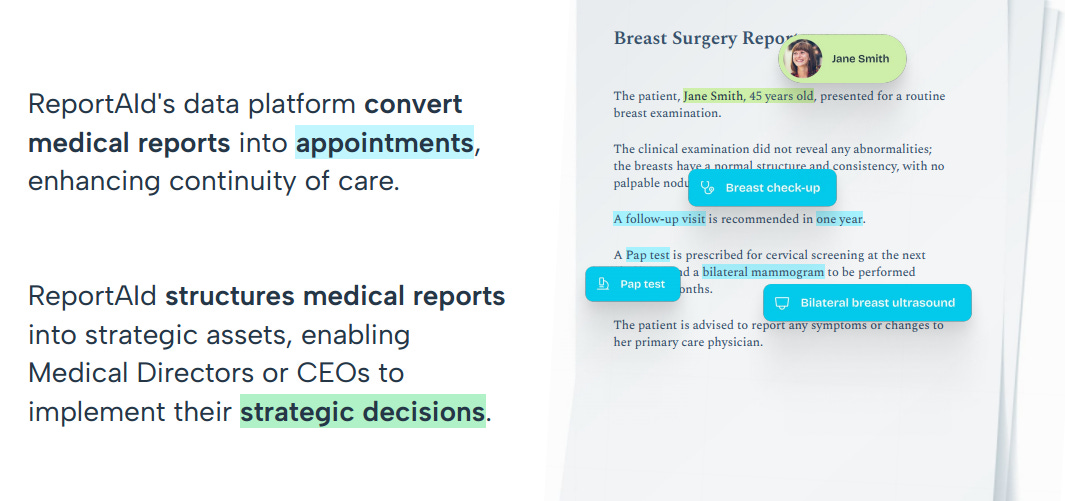
ReportAId’s solution grabbed us because of its elegant simplicity: turn unstructured reports into a to-do list for better healthcare. Using generative AI and natural language processing, their platform reads free-text medical reports (yes, even those multi-page diagnostic epics) and automatically extracts the key data points, diagnoses, recommended tests, follow-up appointments, you name it. Then it does something magical: it acts on that data.
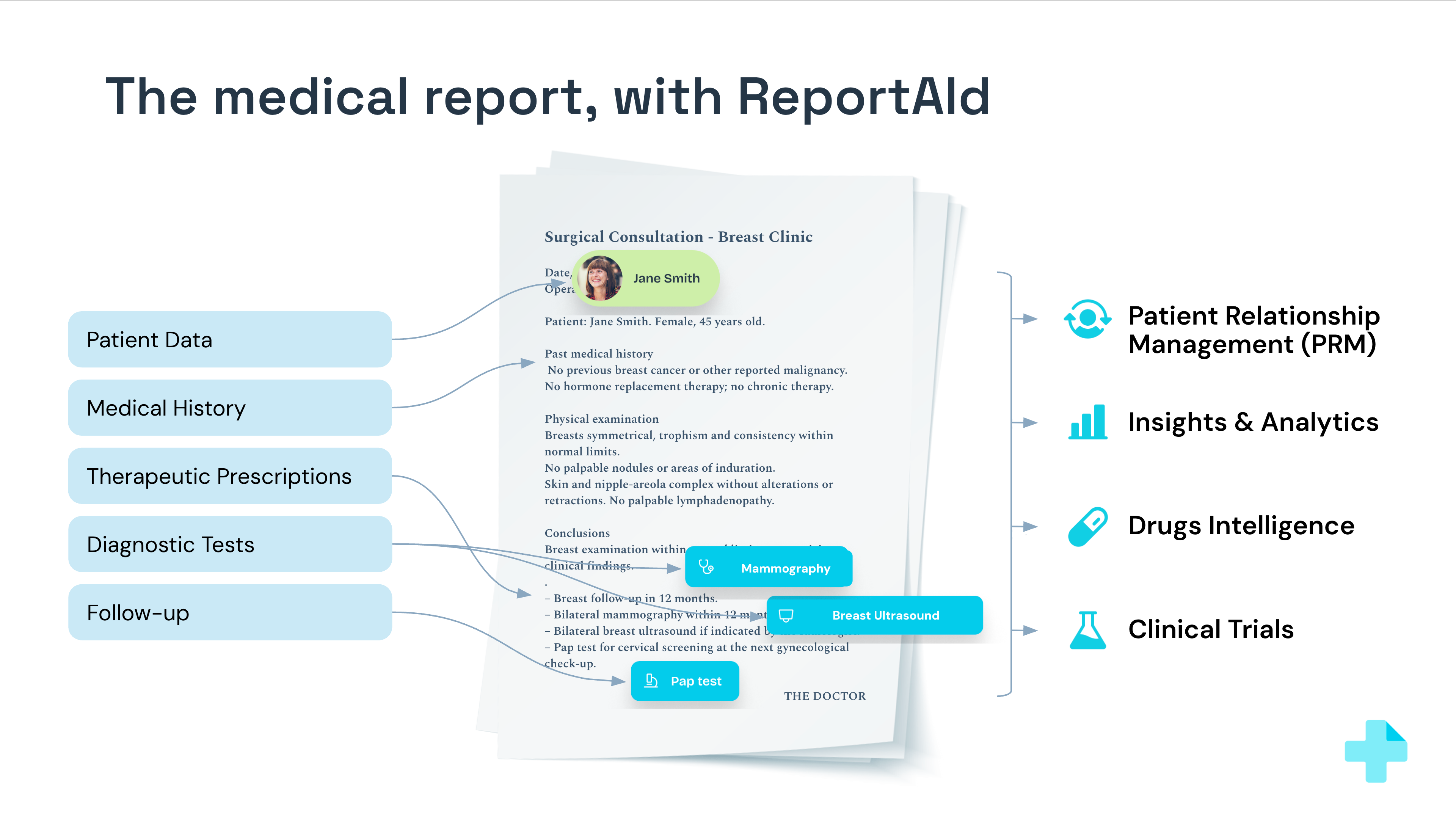
In practice, this means a doctor’s narrative report about “Jane Smith’s breast surgery” gets transformed into a set of concrete, follow-up tasks: e.g. schedule a post-op checkup in 2 weeks, ensure Jane gets a mammogram in 6 months, flag that her pathology report showed X so a specialist consult is needed. What was once just static text is now an interactive care plan. The platform can even integrate with hospital CRMs or messaging systems to contact patients directly with personalized follow-up reminders. No more patients lost to forgetfulness or confusion: the system keeps nudging everyone along the care pathway.
Under the hood, ReportAId’s product has three key modules that address the pain points we saw firsthand in hospitals:
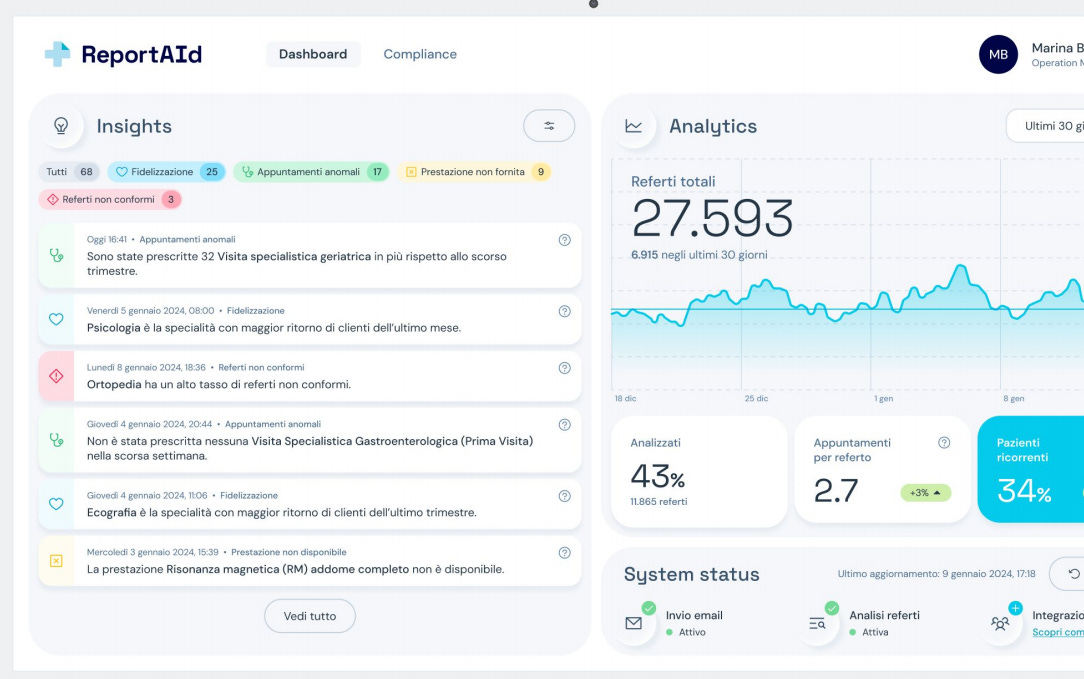
Patient Relationship Management (PRM): This is the heart of the system, where report data is used to generate follow-up appointments, call-back lists, and care plans automatically. It’s like a smart assistant ensuring every patient is proactively managed so they don’t slip away. A physician signs off on a report, and PRM says “Here are the next steps for the patient”, reducing patient drop-off by keeping the loop closed.
Insights & Analytics: By aggregating data across all those reports, ReportAId gives hospital administrators a bird’s-eye view of trends and gaps. Which treatments are most often not followed up? How many patients should be coming back for a check but aren’t? These analytics help optimize services and resource allocation (think smarter capacity planning for that imaging machine). It’s business intelligence built on what was previously invisible data.
Clinical Trials: ReportAId transforms how healthcare institutions find eligible patients for clinical studies. By automatically analyzing medical reports, it builds a reasoned summary of each patient’s clinical history and matches it against active trial protocols - filtering through hundreds of studies in seconds. The system uses a smart three-tier approach: deterministic filters knock out irrelevant trials upfront, structured disease extraction narrows the field further, and advanced AI reasoning is applied only where clinical complexity truly demands it. The result is a dramatic reduction in the manual effort researchers spend screening patients, while surfacing candidates that would otherwise be missed.
Drugs Intelligence: ReportAId extracts every drug from a medical report - validating names, active ingredients, dosages and ATC codes against the AIFA database, and tracking treatment status for each patient. Aggregated at scale, this becomes a live pharmaceutical map of the entire patient population, giving clinical teams the intelligence to spot therapy gaps and optimize care pathways. And because the system knows exactly what each patient needs and when, it opens the door to a genuinely new experience: medications delivered directly to their home, removing the friction that too often turns a prescription into a missed treatment.
Prescriptive Appropriateness: ReportAId reads between the lines of medical reports to build a behavioral profile of each prescribing physician - not just what they diagnosed, but how they acted on it. By cross-referencing prescriptions against the recommendations of leading by scientific societies, the platform flags where doctors are drifting from best practice: the MRI ordered too early, the antibiotic prescribed without a bacterial confirmation, the follow-up skipped entirely. All insights flow exclusively to clinical leadership, turning what was previously anecdotal into a structured, evidence-based tool for training, process improvement, and smarter patient routing. It’s the compliance layer that healthcare organizations always needed but never had the data to build.
By addressing all these areas, the platform boosts patient engagement and care quality in one sweep. Importantly, it does so without adding burden to clinicians. The AI works in the background, so doctors and nurses aren’t clicking more checkboxes or doing extra data entry. (One of our litmus tests for healthtech is: does this actually save time for caregivers? ReportAId passes with flying colors.)
Early Traction: From Pilot to Proof Point
Great ideas are one thing; execution is another. The ReportAId team knew they’d have to prove their value in the field, and they’ve done exactly that. Over the past year, they initiated pilots with some of Italy’s top healthcare institutions, including the renowned San Raffaele Hospital in Milan and Centro Diagnostico Italiano (CDI). They even expanded to work with a major Roman hospital (Ospedale Isola Tiberina, part of the Gemelli network). These aren’t easy customers to win over: they are large, demanding providers, yet ReportAId managed to get in the door and deploy their tech in real clinical environments.
The feedback so far has been extremely promising. We’ve heard about clinicians actually embracing the system because it lightens their admin load (fewer “did Mrs. Rossi ever schedule that follow-up?” nightmares). Hospital managers, on the other hand, love the revenue impact. In some cases, hospitals using ReportAId reported up to a 25% increase in revenue tied to better follow-up capture and service uptake.
Why IFF Invested: Team, Market, and Magic Timing
After following ReportAId’s progress and getting to know the founders, we decided to lead their €2.2m pre-seed round (joined by a roster of awesome co-investors such as Heartfelt, Exceptional Ventures, 2100, Vento, Ithaca). Here are the biggest reasons why we said “yes”, and why we’re so excited about this company:
A Mission-Driven, A+ Team: Simply put, this is a founding team we would bet on in any industry, and it just so happens they’re tackling one they know intimately. CEO Giuseppe Faraci and CTO Claudio Caletti are repeat founders who previously built companies in healthcare and AI (Giuseppe even launched an AI venture called Run2AI, and Claudio co-founded a tech consultancy, Buildo). They also held leadership roles at CMS (Centro Medico Santagostino), one of Italy’s largest private clinic networks, where they lived the data fragmentation problem firsthand. Meanwhile, their Chairman Luca Foresti is the former CEO of that same clinic group (and a bit of a legend in Italian healthcare circles). This trio combines deep healthcare domain insight with technical chops and startup experience, a rare and powerful mix. You can’t easily teach a team to have the kind of hands-on understanding of hospital workflows that Giuseppe and Claudio have, nor the scale-up experience Luca brings. We felt their collective expertise gave them an unfair advantage in building a solution that healthcare folks actually want to use.
Huge Market (& Growing Need): The unstructured medical data problem is not a niche issue at all – it’s huge and growing. In Europe alone, the addressable market for solutions like this is estimated around €13.5 billion (spanning hospitals, clinics, and eventually insurers/National Health Systems). Italy is just the beachhead (with ~€900M of immediate opportunity in private hospitals alone), but the same pain is felt from the NHS in England to providers across the EU. And the timing couldn’t be better: post-pandemic, healthcare providers are under pressure to improve efficiency and patient outcomes, or else. With staffing shortages and burnout at all-time highs, tools that automate admin work and help doctors focus on patients are finding receptive ears. We see ReportAId riding a broader wave where healthcare finally embraces AI-driven workflow tools – a wave that’s only gaining momentum.
Early Validation of Product-Market Fit: We love that ReportAId didn’t spend 3 years in a lab building the “perfect” product. Instead, they quickly entered the market, secured pilot customers, and iterated with real user feedback. The fact that multiple top-tier hospitals signed on and paid for PoCs is strong validation of both the need and the solution’s effectiveness. It de-risks the venture considerably. Moreover, those pilots have yielded reference stories (like the follow-up rate jump mentioned earlier) that will make future sales easier. The execution so far gives us confidence that this team can actually capture the opportunity in front of them.
Unique Positioning vs. Competitors: We always ask, “Why will this team win, as opposed to Epic, or Salesforce, or some AI giant, or another startup?” In ReportAId’s case, we see a first-mover advantage in a space that’s oddly been neglected. There are plenty of companies working on electronic health records and billing systems, and some doing AI transcription or coding assistance. But few, if any, are zeroing in on the content of medical reports to turn them into a strategic asset. ReportAId is carving out this niche and training its AI on very specific clinical text patterns, which is a defensible moat. Could a big EHR company bolt on a basic follow-up reminder feature? Sure, but it likely wouldn’t capture the richness of data that ReportAId’s solution does (nor would it interface as flexibly with existing workflows). In short, the team’s focus on Italy/Europe and on unstructured-report-to-workflow conversion gives them breathing room to build a category-defining product. And they’re mindful of compliance and privacy from day one – a must-have in healthcare that potential Silicon Valley competitors often realize too late. As one industry expert put it after seeing ReportAId, “This is gold for hospitals.” We agree.
Part of a Bigger Trend: AI Meets Healthcare (Finally)
We’d be remiss not to zoom out for a moment. Our investment in ReportAId isn’t happening in a vacuum, it’s part of a broader story of AI in healthcare really taking off. In fact, we weren’t too surprised when OpenAI announced “ChatGPT for Healthcare,” a suite of HIPAA-compliant AI tools for hospitals. (Yes, even the world’s most famous AI lab sees the opportunity in reducing doctors’ paperwork and improving patient guidance!) From Microsoft and Google to a swarm of startups, everyone is looking at ways to apply large language models and AI to clinical workflows. The reason is simple: healthcare desperately needs it. Doctors today spend almost half their day on documentation and admin tasks, contributing to record-high burnout. Patients struggle to navigate their care, as information gets lost in translation. AI can act as the connective tissue – summarizing visits, flagging follow-ups, answering patient questions, and more.
We mention this because it validates the path that ReportAId is on. When OpenAI’s CEO is on stage talking about using GPT-4 to draft referral letters and help manage care pathways, you know this is not a fringe idea. It’s the future. That said, we also believe the winners in this space will need more than just a great model, they’ll need deep understanding of specific healthcare niches, robust integration capabilities, and trust from providers. This is where being a focused, founder-led company like ReportAId is an advantage. They’re not building a generic AI platform; they’re building the platform for turning unstructured clinical text into better care delivery. In doing so, they have the chance to become a category-defining software company at the intersection of clinical workflows and AI.
Reflections and Looking Ahead
On a personal note, what convinced us most to invest in ReportAId was the clarity of the team’s vision and their pragmatism in execution. In our early meetings, Giuseppe (CEO) would articulate the problem in a way that resonated deeply: he painted the picture of a patient not getting a critical follow-up simply because no one had the time to chase her down, and how easily that could be fixed with the right tool. The passion to solve that gap was palpable. Claudio (CTO) showed us a live demo, parsing a real anonymized medical report into a dashboard of tasks and insights in seconds, that was the “wow” moment for us. It wasn’t just slideware; it was a glimpse of how healthcare should work in the 21st century.
For other founders, there’s a lot to learn from how the ReportAId team operates. They picked a huge problem but started with a focused beachhead (private hospitals in Italy) where they could deploy quickly and prove value, before attempting to boil the ocean. They balanced ambition with listening: early user feedback directly shaped their product, and they weren’t afraid to iterate. They also understood the importance of compliance and privacy in earning trust, building those features in early, not as an afterthought. This combination of vision + discipline is something we think every deeptech startup should emulate.
The fact that they raised a substantial round (with international and local investors joining forces) to tackle a European healthcare problem from right here in Milan is a testament to how far the ecosystem has come. Italy has world-class technical talent and domain experts, why shouldn’t the next big healthtech innovation start here? We’re proud to be a founder-led fund that can back founders like Giuseppe and Claudio on their home turf, and we hope this story inspires more Italian entrepreneurs to think big.
In summary, we invested in ReportAId because we see a rare combination of huge impact potential, a stellar team uniquely suited to the challenge, early proof that it works, and timing that couldn’t be better. Unstructured medical data is a trillion-dollar problem hiding in plain sight, and ReportAId is on a mission to solve it one hospital at a time. We’re thrilled to be on this journey with them.
To the ReportAId team: grazie for your trust and for letting us be part of your mission. To our readers (founders, operators, fellow investors): if you’re excited by what you’ve read, don’t hesitate to reach out – whether it’s to learn more about ReportAId or to chat about the broader healthcare AI space. The future of healthcare is being written now, and it’s an incredibly exciting story to be a part of.
IFF Team
Thanks for reading Italian Founders Fund's Substack! Subscribe for free to receive new posts and support our work.